

Black-and-white Mannikin
Lonchura bicolor
Silhouette: Ferran Sayol · PhyloPic
- KingdomAnimalia (Animals)
- PhylumChordata (Chordates)
- ClassAves (Birds)
- OrderPasseriformes (Perching Birds)
- FamilyEstrildidae (Waxbills and Allies)
- GenusLonchura (Typical Munias and Mannikins)
- SpeciesLonchura bicolor (Black-and-white Mannikin)
About the Black-and-white Mannikin
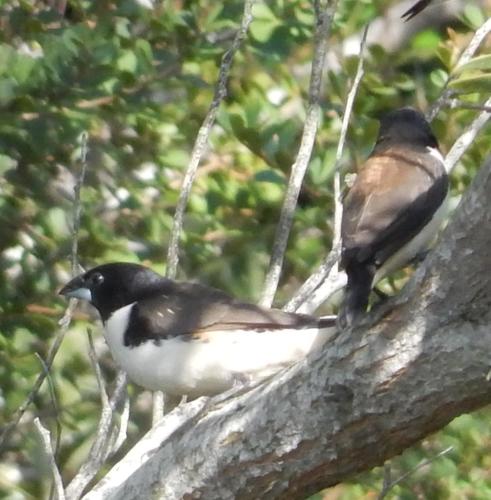
The black-and-white mannikin (Spermestes bicolor) also black-and-white munia or red-backed mannikin, is a species of estrildid finch, widely present throughout sub-Saharan Africa. It has an estimated global extent of occurrence of 4,200,000 km2 (1,600,000 sq mi).
It is found in moist savanna and subtropical or tropical moist lowland forest habitat. The status of the species is evaluated as least concern. They are seedeaters, but are known to feed on algae. The black-and-white mannikin was formally described in 1843 by the British zoologist and collector Louis Fraser from a specimen collected near Cape Palmas in Liberia. He placed the species in the genus Amadina and coined the binomial name Amadina bicolor. The black-and-white mannikin is now one of the four species placed in the genus Spermestes that was introduced in 1837 by William Swainson.
Four subspecies are recognised: S. b. bicolor (Fraser, 1843) – Guinea-Bissau to Cameroon S. b. poensis (Fraser, 1843) – south Cameroon to south Sudan, southwest Ethiopia, west Kenya and the island of Bioko S. b. woltersi (Schouteden, 1956) – southeast DR Congo and northwest Zambia
S. b. nigriceps Cassin, 1852 – central Kenya and south Somalia to east Angola, Zambia, Zimbabwe and east South Africa The subspecies S. b. woltersi and S. b. nigriceps have sometimes been considered as a separate species, the red-backed mannikin. Wikipedia →
Recent sightings of Black-and-white Mannikin in iSimangaliso Wetland Park
LIVEiNaturalistClosest Relatives at iSimangaliso Wetland Park

 Bronze Mannikin
Lonchura cucullata

Brown-backed Munia
Lonchura nigriceps
Magpie Mannikin
Lonchura fringilloides

 Black-tailed Grey Waxbill
Estrilda perreini

 Pink-throated Twinspot
Hypargos margaritatus

Green-backed Twinspot
Mandingoa nitidula

Blue-breasted Cordonbleu
Uraeginthus angolensis

Jameson's Firefinch
Lagonosticta rhodopareia

Green-winged Pytilia
Pytilia melba

Orangebreast
Amandava subflava

African Firefinch
Lagonosticta rubricata

Common Swee Waxbill
Coccopygia melanotis
Global Distribution
Warmer areas are where this animal is recorded most often.
Parks Where Found
Quick answers
What are the chances of seeing a Black-and-white Mannikin in iSimangaliso Wetland Park?
Under 5% of wildlife watchers report a Black-and-white Mannikin sighting in iSimangaliso Wetland Park, based on 78 verified sightings from GBIF citizen-science data.
When is the best time to see Black-and-white Mannikin in iSimangaliso Wetland Park?
March has the highest sighting rate for Black-and-white Mannikin in iSimangaliso Wetland Park in our monthly data.