


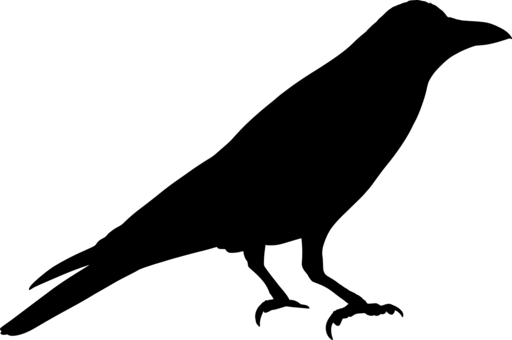
House Crow
Corvus splendens
Silhouette: Andy Wilson · PhyloPic
- KingdomAnimalia (Animals)
- PhylumChordata (Chordates)
- ClassAves (Birds)
- OrderPasseriformes (Perching Birds)
- FamilyCorvidae (Crows, Jays, and Magpies)
- GenusCorvus (Crows and Ravens)
- SpeciesCorvus splendens (House Crow)
About the House Crow
The house crow (Corvus splendens), also known as the Indian, greynecked, Ceylon or Colombo crow, is a common bird of the crow family that is of Asian origin but now found in many parts of the world, where they arrived assisted by shipping. It is between the jackdaw and the carrion crow in size (40 cm (16 in) in length) but is slimmer than either. The forehead, crown, throat and upper breast are a richly glossed black, whilst the neck and breast are a lighter grey-brown in colour. The wings, tail and legs are black. There are regional variations in the thickness of the bill and the depth of colour in areas of the plumage.
The house crow was formally described in 1817 as Corvus splendens by the French ornithologist Louis Vieillot based on a specimen collected in Bengal. The specific epithet is from Latin splendens, splendentis meaning "brilliant" or "glittering".
The nominate race C. s. splendens is found in Pakistan, India, Nepal and Bangladesh and has a grey neck collar. The subspecies C. s. zugmayeri is found in the dry parts of South Asia and Iran and has a very pale neck collar. The subspecies C. s. protegatus is found in southern India, the Maldives (sometimes separated... Wikipedia →
Recent sightings of House Crow in Kinabatangan Wildlife Sanctuary
LIVEiNaturalistClosest Relatives at Kinabatangan Wildlife Sanctuary

 Slender-billed Crow
Corvus enca

 Crested Jay
Platylophus galericulatus

Black-and-red Broadbill
Cymbirhynchus macrorhynchos

 Javan Myna
Acridotheres javanicus

Ashy Tailorbird
Orthotomus ruficeps

 Malaysian Pied-Fantail
Rhipidura javanica

 White-crowned Shama
Copsychus stricklandii
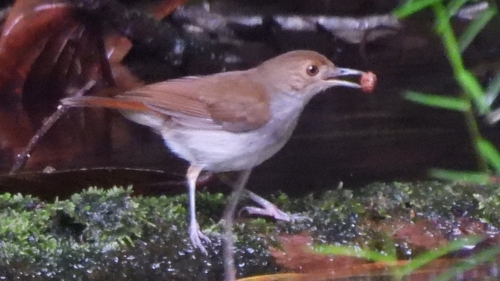
 White-chested Babbler
Trichastoma rostratum

Black-and-yellow Broadbill
Eurylaimus ochromalus

 Malaysian Blue-Flycatcher
Cyornis turcosus

 Hooded Pitta
Pitta sordida

 Common Hill Myna
Gracula religiosa
Global Distribution
Warmer areas are where this animal is recorded most often.
Parks Where Found
Quick answers
What are the chances of seeing a House Crow in Kinabatangan Wildlife Sanctuary?
Under 5% of wildlife watchers report a House Crow sighting in Kinabatangan Wildlife Sanctuary, based on 45 verified sightings from GBIF citizen-science data.
When is the best time to see House Crow in Kinabatangan Wildlife Sanctuary?
June has the highest sighting rate for House Crow in Kinabatangan Wildlife Sanctuary in our monthly data.