



White-throated Fantail
Rhipidura albicollis
Silhouette: Michael Scroggie · PhyloPic
- KingdomAnimalia (Animals)
- PhylumChordata (Chordates)
- ClassAves (Birds)
- OrderPasseriformes (Perching Birds)
- FamilyRhipiduridae (Fantails)
- GenusRhipidura (Fantails)
- SpeciesRhipidura albicollis (White-throated Fantail)
About the White-throated Fantail
The white-throated fantail (Rhipidura albicollis) is a small passerine bird. It is found in forest, scrub and cultivation across tropical southern Asia from the Himalayas, India and Bangladesh east to Indonesia. The white-spotted fantail (R. albogularis) until recently was considered a subspecies.
The adult white-throated fantail is about 19 cm (7.5 in) long. It has a dark fan-shaped tail, edged in white, and white supercilium and throat. There is otherwise much variation in plumage between races. Most resemble the Himalayan R. a. canescans, which is primarily slate grey above and below, featuring a black eye mask, and a white throat and eyebrow.
Local names for the bird in India include Nasoni sorai (Assamese). The white-throated fantail lays three eggs in a small cup nest in a tree. It is insectivorous, and often fans its tail as it moves through the undergrowth.
The eggs are approximately 2 cm (0.79 in) in length. They are white in colour, with a band of brown spots around the middle, closer towards the base of the egg. Birds use the same song year after year, with progressively small changes, with the result that the song sounds very different... Wikipedia →
Recent sightings of White-throated Fantail in Kinabatangan Wildlife Sanctuary
LIVEiNaturalistClosest Relatives at Kinabatangan Wildlife Sanctuary

 Malaysian Pied-Fantail
Rhipidura javanica

Spotted Fantail
Rhipidura perlata

 Slender-billed Crow
Corvus enca

 Black-and-red Broadbill
Cymbirhynchus macrorhynchos

 Javan Myna
Acridotheres javanicus

Ashy Tailorbird
Orthotomus ruficeps

 White-crowned Shama
Copsychus stricklandii
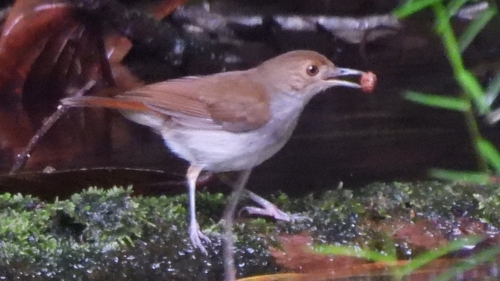
 White-chested Babbler
Trichastoma rostratum

Black-and-yellow Broadbill
Eurylaimus ochromalus

 Malaysian Blue-Flycatcher
Cyornis turcosus

 Hooded Pitta
Pitta sordida

 Common Hill Myna
Gracula religiosa
Global Distribution
Warmer areas are where this animal is recorded most often.
Parks Where Found
| # | Park | Country | Daily sighting probability |
|---|---|---|---|
| 1 | Kinabalu Park | 🇲🇾 Malaysia | |
| 2 | Kerinci Seblat National Park | 🇮🇩 Indonesia | |
| 3 | Namdapha National Park | 🇮🇳 India | |
| 4 | Jim Corbett National Park | 🇮🇳 India | |
| 5 | Sundarbans National Park | 🇮🇳 India | |
| 6 | Khangchendzonga National Park | 🇮🇳 India | |
| 7 | Cuc Phuong National Park | 🇻🇳 Vietnam | |
| 8 | Doi Inthanon National Park | 🇹🇭 Thailand | |
| 9 | Royal Manas National Park | 🇧🇹 Bhutan | |
| 10 | Manas National Park | 🇮🇳 India | |
| 11 | Chitwan National Park | 🇳🇵 Nepal | |
| 12 | Royal Bardia National Park | 🇳🇵 Nepal | |
| 13 | Langtang National Park | 🇳🇵 Nepal | |
| 14 | Kaeng Krachan National Park | 🇹🇭 Thailand | |
| 15 | Danum Valley Conservation Area | 🇲🇾 Malaysia | |
| 16 | Kaziranga National Park | 🇮🇳 India | |
| 17 | Sepilok | 🇲🇾 Malaysia | |
| 18 | Gunung Leuser National Park | 🇮🇩 Indonesia | |
| 19 | Tanjung Puting National Park | 🇮🇩 Indonesia | |
| 20 | Taman Negara National Park | 🇲🇾 Malaysia | |
| 21 | Kinabatangan Wildlife Sanctuary | 🇲🇾 Malaysia |