


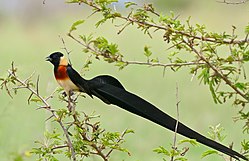


Long-tailed Paradise Whydah
Vidua paradisaea
Silhouette: Sheatherius · PhyloPic
- KingdomAnimalia (Animals)
- PhylumChordata (Chordates)
- ClassAves (Birds)
- OrderPasseriformes (Perching Birds)
- FamilyViduidae (Indigobirds and Whydahs)
- GenusVidua (Indigobirds and Whydahs)
- SpeciesVidua paradisaea (Long-tailed Paradise Whydah)
About the Long-tailed Paradise Whydah
The long-tailed paradise whydah or eastern paradise whydah (Vidua paradisaea) is a bird in the family Viduidae of the order Passeriformes. It is a small passerine with a short, stubby bill, found across eastern and southern Africa from Ethiopia south to South Africa and west to Angola. It is mostly granivorous, and feed on seeds that have ripened and fallen on the ground. The ability to distinguish between males and females is quite difficult unless it is breeding season. During this time, the males moult into breeding plumage where they have a distinctive long tail. This can be up to three times longer than its own body or even more. Males are able to mimic songs where females can use that to discover their mate. However, there are some cases where females don't use songs to choose their mate but they use either male characteristics like plumage or they can have a shortage of options with song mimicry. Paradise whydahs are brood parasites. They do not destroy the host eggs that are originally there, but lay their own eggs alogside in the other bird's nest. Overall, these whydahs are considered least concern, based on the IUCN Red List of threatened species. Wikipedia →
Recent sightings of Long-tailed Paradise Whydah in Kruger National Park
LIVEiNaturalistClosest Relatives at Kruger National Park

 Pin-tailed Whydah
Vidua macroura

 Village Indigobird
Vidua chalybeata

Purple Indigobird
Vidua purpurascens

Black Widowfinch
Vidua funerea

Shaft-tailed Whydah
Vidua regia

Cuckoo Finch
Anomalospiza imberbis

 Fork-tailed Drongo
Dicrurus adsimilis

 Common Bulbul
Pycnonotus barbatus

Red-billed Oxpecker
Buphagus erythrorhynchus

Blue-breasted Cordonbleu
Uraeginthus angolensis

 Magpie Shrike
Urolestes melanoleucus

Black-backed Puffback
Dryoscopus cubla
Global Distribution
Warmer areas are where this animal is recorded most often.
Parks Where Found
Quick answers
What are the chances of seeing a Long-tailed Paradise Whydah in Kruger National Park?
About 10% of wildlife watchers report a Long-tailed Paradise Whydah sighting in Kruger National Park, based on 1,507 verified sightings from GBIF citizen-science data.
When is the best time to see Long-tailed Paradise Whydah in Kruger National Park?
January has the highest sighting rate for Long-tailed Paradise Whydah in Kruger National Park in our monthly data.