


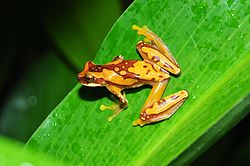

Harlequin Treefrog
Dendropsophus ebraccatus
Silhouette: Dmitry Bogdanov (vectorized by T. Michael Keesey) · PhyloPic
- KingdomAnimalia (Animals)
- PhylumChordata (Chordates)
- ClassAmphibia (Amphibians)
- OrderAnura (Frogs and Toads)
- FamilyHylidae (Hylid Tree Frogs)
- GenusDendropsophus (Yellow Tree Frogs)
- SpeciesDendropsophus ebraccatus (Harlequin Treefrog)
About the Harlequin Treefrog
Dendropsophus ebraccatus, also known as the hourglass treefrog, referring to the golden-brown hourglass shape seen surrounded by skin yellow on its back. Their underbellies are yellow. Their arms and lower legs usually display bold patterns while their upper legs or thighs are light yellow giving them the appearance of wearing no pants. The species name "ebraccata" translates to "without trousers" in Latin.
The hourglass treefrog is throughout Mexico from southern Veracruz and northern Oaxaca, slightly more southern in Chiapas, Tabasco, and the Yucatán Peninsula. The hourglass treefrog also presides south of Mexico in the northern Guatemala and Belize areas. The range of the hourglass treefrog becomes more scarce in Honduras and a few more known locations in Nicaragua, but then has been commonly reported again in Central America spanning from Costa Rica to Panama even venturing into Colombia and northwestern Ecuador.
Dendropsophus ebraccatus is a member of the wide-ranging tree frog family Hylidae and the genus Dendropsophus. Dendropsophus is a group of small, primarily yellow tree frogs found throughout Central and South America. A unique feature of the genus is that... Wikipedia →
Recent sightings of Harlequin Treefrog in Gandoca-Manzanillo Wildlife Refuge
LIVEiNaturalistClosest Relatives at Gandoca-Manzanillo Wildlife Refuge

 Masked Tree Frog
Smilisca phaeota

 Sipurio Snouted Treefrog
Scinax elaeochroa

 Red-webbed Tree Frog
Boana rufitela

Boulenger's Snouted Tree Frog
Scinax boulengeri

Mahogany Tree Frog
Tlalocohyla loquax

Drab Tree Frog
Smilisca sordida

Eastern Masked Tree Frog
Smilisca manisorum

 Strawberry Poison-dart Frog
Oophaga pumilio

Green and Black Dart-poison Frog
Dendrobates auratus

 Red-eyed Treefrog
Agalychnis callidryas

Sylvia's Tree Frog
Cruziohyla sylviae

 Striped Poison-Dart Frog
Phyllobates lugubris
Global Distribution
Warmer areas are where this animal is recorded most often.
Parks Where Found
Quick answers
What are the chances of seeing a Harlequin Treefrog in Gandoca-Manzanillo Wildlife Refuge?
About 30% of wildlife watchers report a Harlequin Treefrog sighting in Gandoca-Manzanillo Wildlife Refuge, based on 40 verified sightings from GBIF citizen-science data.
When is the best time to see Harlequin Treefrog in Gandoca-Manzanillo Wildlife Refuge?
August has the highest sighting rate for Harlequin Treefrog in Gandoca-Manzanillo Wildlife Refuge in our monthly data.