

Cockatiel
Nymphicus hollandicus
Silhouette: Matias · PhyloPic
- KingdomAnimalia (Animals)
- PhylumChordata (Chordates)
- ClassAves (Birds)
- OrderPsittaciformes (Parrots)
- FamilyPsittacidae (New World and African Parrots)
- GenusNymphicus (Cockatiels)
- SpeciesNymphicus hollandicus (Cockatiel)
About the Cockatiel
The cockatiel (Nymphicus hollandicus), also known as the weero/weiro or quarrion, is a species of small- to medium-sized parrot belonging to the cockatoo family (Cacatuidae), of which it is the smallest member. Native to Australia, it is the sole member of the genus Nymphicus.
Cockatiels are widely recognized for their expressive crests, long tail feathers, and sociable, playful nature, and their strong affinity for human interaction has made them among the most commonly kept companion parrots worldwide and one of the five most popular pet bird species; an estimated 4.8 million US households keep them. However, insufficient knowledge of their care contributes to one of the highest surrender rates among pet bird species.
Proper care requires regular social interaction with owners, as well as a suitable nutritionally appropriate diet, toy-based enrichment, annual veterinary check-ups and prompt attention when signs of illness or respiratory issues appear, perches of varying diameters, UV exposure, and about two hours of daily out-of-cage time. Due to many owners' unfamiliarity with these requirements, many cockatiels suffer chronic malnutrition and behavioral problems and are often relinquished to shelters within approximately 1.5 years of adoption.
The cockatiel is the only member of the genus Nymphicus. It was previously unclear whether the cockatiel is a crested parakeet or small cockatoo; however, more recent molecular studies have assigned it to its own subfamily, Nymphicinae. It is, therefore, now classified as the smallest subfamily of the Cacatuidae (cockatoo family). Cockatiels are native to Australia, favouring the Australian wetlands, scrublands, and bushlands. There are many different mutations of this bird. Wikipedia →
Recent sightings of Cockatiel in Marino Ballena National Park
LIVEiNaturalistClosest Relatives at Marino Ballena National Park

 Scarlet Macaw
Ara macao

 Orange-chinned Parakeet
Brotogeris jugularis

 Red-lored Parrot
Amazona autumnalis
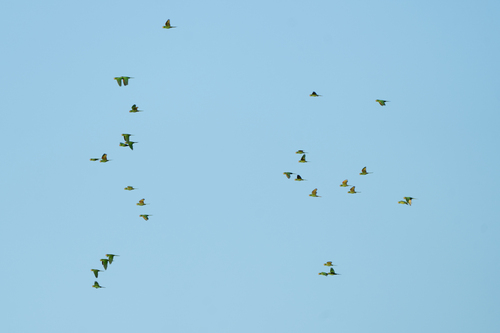
 Crimson-fronted Parakeet
Aratinga finschi

Mealy Parrot
Amazona farinosa

 White-crowned Parrot
Pionus senilis

Brown-hooded Parrot
Pionopsitta haematotis

 Orange-fronted Parakeet
Aratinga canicularis

Blue-headed Parrot
Pionus menstruus
Global Distribution
Warmer areas are where this animal is recorded most often.
Parks Where Found
| # | Park | Country | Daily sighting probability |
|---|---|---|---|
| 1 | Uluru-Kata Tjuta National Park | 🇦🇺 Australia | |
| 2 | Cape Range | 🇦🇺 Australia | |
| 3 | Ningaloo Marine Park | 🇦🇺 Australia | |
| 4 | Nitmiluk National Park | 🇦🇺 Australia | |
| 5 | Everglades National Park | 🇺🇸 United States | |
| 6 | Sierra de Guadarrama National Park | 🇪🇸 Spain | |
| 7 | Flinders Ranges National Park | 🇦🇺 Australia | |
| 8 | Kakadu National Park | 🇦🇺 Australia | |
| 9 | Arrecifes de Cozumel National Park | 🇲🇽 Mexico | |
| 10 | Tijuca National Park | 🇧🇷 Brazil | |
| 11 | Cañón del Sumidero National Park | 🇲🇽 Mexico | |
| 12 | Celestún Biosphere Reserve | 🇲🇽 Mexico | |
| 13 | Marino Ballena National Park | 🇨🇷 Costa Rica | |
| 14 | Doi Inthanon National Park | 🇹🇭 Thailand | |
| 15 | Iguazú National Park | 🇦🇷 Argentina | |
| 16 | Wadden Sea National Park | 🇩🇪 Germany | |
| 17 | Saguaro National Park | 🇺🇸 United States |