


Red-capped Lark
Calandrella cinerea
Silhouette: Gossipguy and T. Michael Keesey · PhyloPic
- KingdomAnimalia (Animals)
- PhylumChordata (Chordates)
- ClassAves (Birds)
- OrderPasseriformes (Perching Birds)
- FamilyAlaudidae (Larks)
- GenusCalandrella (Calandrella Short-toed Larks)
- SpeciesCalandrella cinerea (Red-capped Lark)
About the Red-capped Lark
The red-capped lark (Calandrella cinerea) is a small passerine bird that breeds in the highlands of eastern Africa southwards from Ethiopia and Somaliland. In the south, its range stretches across the continent to Angola and south to the Cape in South Africa.
The red-capped lark was formally described in 1789 by the German naturalist Johann Friedrich Gmelin in his revised and expanded edition of Carl Linnaeus's Systema Naturae. He placed it with the larks in the genus Alauda and coined the binomial name Alauda cinerea. Gmelin based his description on "la Cendrille" from the Cape of Good Hope that had been described by the French polymath Comte de Buffon in 1778 and the "cinereous lark" that had been described by the English ornithologist John Latham in 1783. The red-capped lark is now one of six species placed in the genus Calandrella that was introduced in 1829 by the German naturalist Johann Jakob Kaup. The genus name is a diminutive of Ancient Greek kalandros, the calandra lark. The specific epithet cinerea is from Latin cinereus meaning "ash-grey" or "ash-coloured".
The red-capped lark was formerly considered to be conspecific with the Mongolian lark (Calandrella... Wikipedia →
Recent sightings of Red-capped Lark in Ngorongoro Conservation Area
LIVEiNaturalistClosest Relatives at Ngorongoro Conservation Area
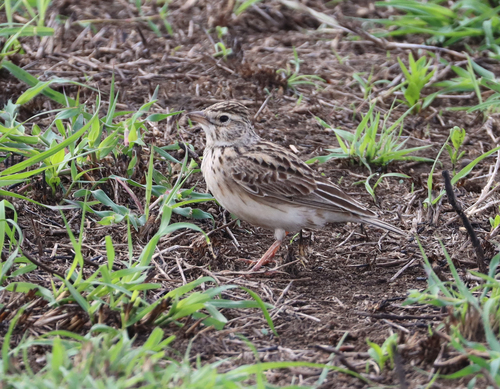
 Somali Short-toed Lark
Calandrella somalica

 Fischer's Sparrow-Lark
Eremopterix leucopareia

Fawn-colored Lark
Calendulauda africanoides

Short-tailed Lark
Pseudalaemon fremantlii

White-tailed Lark
Mirafra albicauda

 Chestnut-backed Sparrow-Lark
Eremopterix leucotis

Australasian Bushlark
Mirafra javanica

Latakoo Lark
Mirafra cheniana

Pink-breasted Lark
Calendulauda poecilosterna

 Superb Starling
Lamprotornis superbus

 Common Bulbul
Pycnonotus barbatus

 Rufous-tailed Weaver
Histurgops ruficauda
Global Distribution
Warmer areas are where this animal is recorded most often.
Parks Where Found
Quick answers
What are the chances of seeing a Red-capped Lark in Ngorongoro Conservation Area?
About 20% of wildlife watchers report a Red-capped Lark sighting in Ngorongoro Conservation Area, based on 825 verified sightings from GBIF citizen-science data.
When is the best time to see Red-capped Lark in Ngorongoro Conservation Area?
April has the highest sighting rate for Red-capped Lark in Ngorongoro Conservation Area in our monthly data.