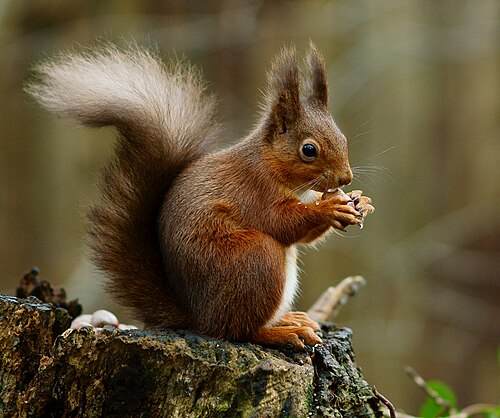


Eurasian Red Squirrel
Sciurus vulgaris
- KingdomAnimalia (Animals)
- PhylumChordata (Chordates)
- ClassMammalia (Mammals)
- OrderRodentia (Rodents)
- FamilySciuridae (Squirrels)
- GenusSciurus (Tree Squirrels)
- SpeciesSciurus vulgaris (Eurasian Red Squirrel)
About the Eurasian Red Squirrel
The red squirrel (Sciurus vulgaris), also called Eurasian red squirrel, is a species of tree squirrel in the genus Sciurus. It is an arboreal and primarily herbivorous rodent and common throughout Eurasia. There have been over 40 described subspecies of the red squirrel, but the taxonomic status of some of these is uncertain. A study published in 1971 recognises 16 subspecies and has served as a basis for subsequent taxonomic work. Although the validity of some subspecies is labelled with uncertainty because of the large variation in red squirrels even within a single region, others are relatively distinctive. At present, there are 23 recognized subspecies of the red squirrel.
A number of subspecies of S. vulgaris have been classified as distinct species. S. v. meridionalis of South Italy was elevated to species status as the Calabrian black squirrel in 2017, which descends from a single source population in central Calabria that became isolated in the Middle Pleistocene. The Japanese squirrel, Sciurus lis, was also historically classified as a subspecies of S. vulgaris, although scientific opinion shifted towards classifying it as a distinct species beginning in the... Wikipedia →
Closest Relatives at Plitvice Lakes National Park


Global Distribution
Where this species is recorded worldwide. Restricted to human observations from 2019 onwards — the same kind of record and the same period the probabilities on this page are built from, so collar-tracking studies, camera-trap arrays and museum specimens are excluded. Around Santa Rosa that removes 5,924 GPS fixes from a handful of tagged jaguars.
where this species is recorded (GBIF density — it tracks where observers go, not how likely a sighting is) · parks where it occurs — tap a pin for the sighting probability there
Parks Where Found
| # | Park | Country | Daily sighting probability |
|---|---|---|---|
| 1 | Cairngorms National Park | 🇬🇧 United Kingdom | |
| 2 | Białowieża National Park | 🇵🇱 Poland | |
| 3 | Tatra National Park | 🇸🇰 Slovakia | |
| 4 | Triglav National Park | 🇸🇮 Slovenia | |
| 5 | Sierra Nevada National Park | 🇪🇸 Spain | |
| 6 | Hohe Tauern National Park | 🇦🇹 Austria | |
| 7 | Biebrza National Park | 🇵🇱 Poland | |
| 8 | Bavarian Forest National Park | 🇩🇪 Germany | |
| 9 | Pyrénées National Park | 🇫🇷 France | |
| 10 | Mercantour National Park | 🇫🇷 France | |
| 11 | Plitvice Lakes National Park | 🇭🇷 Croatia | |
| 12 | Vanoise National Park | 🇫🇷 France | |
| 13 | Snowdonia National Park | 🇬🇧 United Kingdom | |
| 14 | Ecrins National Park | 🇫🇷 France | |
| 15 | Cévennes National Park | 🇫🇷 France | |
| 16 | Picos de Europa National Park | 🇪🇸 Spain | |
| 17 | Fertő-Hanság National Park | 🇭🇺 Hungary | |
| 18 | Aigüestortes National Park | 🇪🇸 Spain | |
| 19 | Wadden Sea National Park | 🇩🇪 Germany | |
| 20 | Kiskunság National Park | 🇭🇺 Hungary | |
| 21 | Sierra de Guadarrama National Park | 🇪🇸 Spain | |
| 22 | Gauja National Park | 🇱🇻 Latvia | |
| 23 | Ordesa y Monte Perdido National Park | 🇪🇸 Spain | |
| 24 | Camargue | 🇫🇷 France |
Quick answers
What are the chances of seeing a Eurasian Red Squirrel in Plitvice Lakes National Park?
About 20% of wildlife watchers report a Eurasian Red Squirrel sighting in Plitvice Lakes National Park, based on 5 verified sightings from GBIF citizen-science data.
When is the best time to see Eurasian Red Squirrel in Plitvice Lakes National Park?
March has the highest sighting rate for Eurasian Red Squirrel in Plitvice Lakes National Park in our monthly data.