


Bar-tailed Godwit
Limosa lapponica
- KingdomAnimalia (Animals)
- PhylumChordata (Chordates)
- ClassAves (Birds)
- OrderCharadriiformes (Shorebirds and Allies)
- FamilyScolopacidae (Sandpipers and Allies)
- GenusLimosa (Godwits)
- SpeciesLimosa lapponica (Bar-tailed Godwit)
About the Bar-tailed Godwit
The bar-tailed godwit (Limosa lapponica) is a large and strongly migratory wader in the family Scolopacidae, which feeds on bristle-worms and shellfish on coastal mudflats and estuaries. It has distinctive red breeding plumage, long legs, and a long upturned bill. Bar-tailed godwits breed on Arctic coasts and tundra from Scandinavia to Alaska, and overwinter on coasts in temperate and tropical regions of Australia and New Zealand. The migration of the subspecies Limosa lapponica baueri across the Pacific Ocean from Alaska to New Zealand is the longest known non-stop flight of any bird, and also the longest journey without pausing to feed by any animal. The round-trip migration for this subspecies is over 29,000 km (18,020 mi).
The bar-tailed godwit was formally described by the Swedish naturalist Carl Linnaeus in 1758 in the tenth edition of his Systema Naturae under the binomial name Scolopax limosa. It is now placed with three other godwits in the genus Limosa that was introduced by the French zoologist Mathurin Jacques Brisson in 1760. The genus name Limosa is from Latin and means "muddy", from limus, "mud", referring to its preferred habitat. The specific name lapponica... Wikipedia →
Closest Relatives at Raja Ampat

Black-tailed Godwit
Limosa limosa
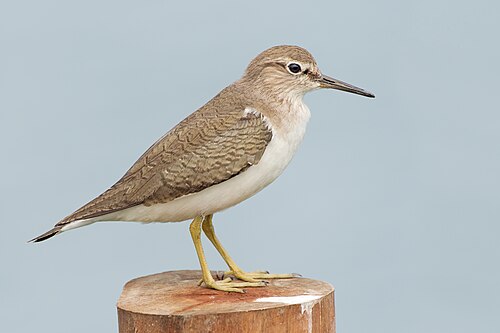
Common Sandpiper
Actitis hypoleucos

Whimbrel
Numenius phaeopus

Red-necked Phalarope
Phalaropus lobatus

Grey-tailed Tattler
Tringa brevipes

Great Knot
Calidris tenuirostris

Curlew Sandpiper
Calidris ferruginea

Little Stint
Calidris minuta

Common Greenshank
Tringa nebularia

Wood Sandpiper
Tringa glareola

Sharp-tailed Sandpiper
Calidris acuminata

Ruddy Turnstone
Arenaria interpres
Global Distribution
Where this species is recorded worldwide. Restricted to human observations from 2019 onwards — the same kind of record and the same period the probabilities on this page are built from, so collar-tracking studies, camera-trap arrays and museum specimens are excluded. Around Santa Rosa that removes 5,924 GPS fixes from a handful of tagged jaguars.
where this species is recorded (GBIF density — it tracks where observers go, not how likely a sighting is) · parks where it occurs — tap a pin for the sighting probability there
Parks Where Found
Quick answers
What are the chances of seeing a Bar-tailed Godwit in Raja Ampat?
Under 5% of wildlife watchers report a Bar-tailed Godwit sighting in Raja Ampat, based on 18 verified sightings from GBIF citizen-science data.
When is the best time to see Bar-tailed Godwit in Raja Ampat?
November has the highest sighting rate for Bar-tailed Godwit in Raja Ampat in our monthly data.