


Northern Mockingbird
Mimus polyglottos
- KingdomAnimalia (Animals)
- PhylumChordata (Chordates)
- ClassAves (Birds)
- OrderPasseriformes (Perching Birds)
- FamilyMimidae (Mockingbirds and Thrashers)
- GenusMimus (Typical Mockingbirds)
- SpeciesMimus polyglottos (Northern Mockingbird)
About the Northern Mockingbird
The northern mockingbird (Mimus polyglottos) is a mockingbird commonly found in North America, of the family Mimidae. The species is also found in some parts of the Caribbean, as well as on the Hawaiian Islands. It is typically a permanent resident across much of its range, but northern mockingbirds may move farther south during inclement weather or prior to the onset of winter. The northern mockingbird has gray to brown upper feathers and a paler belly. Its tail and wings have white patches which are visible in flight.
The species is known for its ability to mimic bird calls and other types of sound, including artificial and electronic noises. Studies have shown its ability to identify individual humans and treat them differently based on learned threat assessments. It is an omnivore and consumes fruit, invertebrates, and small vertebrates. It is often found in open areas, open woodlands and forest edges, and is quite common in urbanized areas. The species breeds from southeastern Canada throughout the United States to the Greater Antilles. It is listed as a species of least concern by the International Union for Conservation of Nature.
The mockingbird is influential in United States culture, being the state bird of five states, appearing in book titles, songs and lullabies, and making other appearances in popular culture. Wikipedia →
Closest Relatives at Saguaro National Park

Curve-billed Thrasher
Toxostoma curvirostre

Crissal Thrasher
Toxostoma crissale
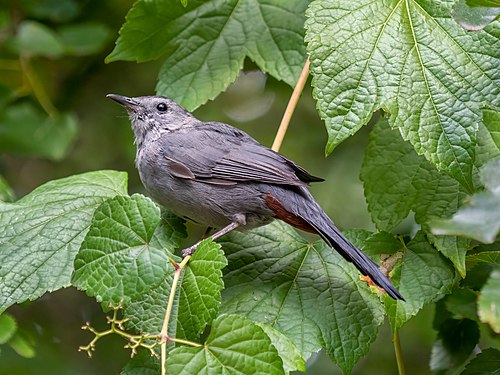
Gray Catbird
Dumetella carolinensis

Sage Thrasher
Oreoscoptes montanus

Brown Thrasher
Toxostoma rufum

Bendire's Thrasher
Toxostoma bendirei

Verdin
Auriparus flaviceps

House Finch
Haemorhous mexicanus

Lesser Goldfinch
Spinus psaltria

Abert's Towhee
Melozone aberti

Vermilion Flycatcher
Pyrocephalus rubinus

Yellow-rumped Warbler
Setophaga coronata
Global Distribution
Where this species is recorded worldwide. Restricted to human observations from 2019 onwards — the same kind of record and the same period the probabilities on this page are built from, so collar-tracking studies, camera-trap arrays and museum specimens are excluded. Around Santa Rosa that removes 5,924 GPS fixes from a handful of tagged jaguars.
where this species is recorded (GBIF density — it tracks where observers go, not how likely a sighting is) · parks where it occurs — tap a pin for the sighting probability there
Parks Where Found
Quick answers
What are the chances of seeing a Northern Mockingbird in Saguaro National Park?
About 30% of wildlife watchers report a Northern Mockingbird sighting in Saguaro National Park, based on 19,385 verified sightings from GBIF citizen-science data.
When is the best time to see Northern Mockingbird in Saguaro National Park?
October has the highest sighting rate for Northern Mockingbird in Saguaro National Park in our monthly data.