



Brown-throated Wattle-eye
Platysteira cyanea
Silhouette: Sheatherius · PhyloPic
- KingdomAnimalia (Animals)
- PhylumChordata (Chordates)
- ClassAves (Birds)
- OrderPasseriformes (Perching Birds)
- FamilyPlatysteiridae (Wattle-eyes and Batises)
- GenusPlatysteira (Wattle-eyes)
- SpeciesPlatysteira cyanea (Brown-throated Wattle-eye)
About the Brown-throated Wattle-eye
The brown-throated wattle-eye (Platysteira cyanea), also known as the common wattle-eye or scarlet-spectacled wattle-eye, is a small, insectivorous passerine bird. The wattle-eyes were previously classed as a subfamily of the Old World flycatcher family Muscicapidae, but are now usually separated from that group.
This species breeds in west, central and northeast tropical Africa. This common species is found in secondary forest and other woodland areas, including gardens. The eggs are laid in a small neat lichen and cobweb cup low in a tree or bush.
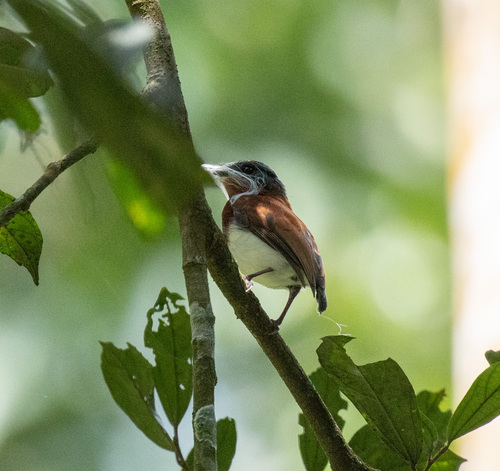
The adult brown-throated wattle-eye is a stout bird about 14 cm (5.5 in) long. The breeding male has glossy black upperparts, and white underparts with a neat black breast band. There is a strong white wingbar, and fleshy red wattles above the eye.
The females are grey-black above, and also have the white wing bar and red wattles. There is a small patch of white below the bill, and the throat and breast are maroon, separated from the white belly by the black breast band. Young males are washed-out, greyer versions of the female.
These active insect-eating birds are found in pairs or small groups. The ringing call of the brown-throated wattle-eye is a very characteristic six note doo-dd-dum-di-do-do. Wikipedia →
Recent sightings of Brown-throated Wattle-eye in Semuliki National Park
LIVEiNaturalistClosest Relatives at Semuliki National Park

 Jameson's Wattle-eye
Platysteira jamesoni

Yellow-bellied Wattle-eye
Platysteira concreta
Chestnut Wattle-eye
Dyaphorophyia castanea

Black-and-white Shrike-flycatcher
Bias musicus

African Shrike-flycatcher
Megabyas flammulatus

 Ituri Batis
Batis ituriensis

Western Black-headed Batis
Batis erlangeri

Chinspot Batis
Batis molitor

Crested Malimbe
Malimbus malimbicus

 Red-tailed Greenbul
Criniger calurus

Western Nicator
Nicator chloris

 Fraser's Rufous Thrush
Stizorhina fraseri
Global Distribution
Warmer areas are where this animal is recorded most often.
Parks Where Found
| # | Park | Country | Daily sighting probability |
|---|---|---|---|
| 1 | Kibale National Park | 🇺🇬 Uganda | |
| 2 | Bwindi Impenetrable National Park | 🇺🇬 Uganda | |
| 3 | Niokolo-Koba National Park | 🇸🇳 Senegal | |
| 4 | Virunga National Park | 🇨🇩 Democratic Republic of the Congo | |
| 5 | Queen Elizabeth National Park | 🇺🇬 Uganda | |
| 6 | Murchison Falls National Park | 🇺🇬 Uganda | |
| 7 | Lake Mburo National Park | 🇺🇬 Uganda | |
| 8 | Nyungwe National Park | 🇷🇼 Rwanda | |
| 9 | Masai Mara National Reserve | 🇰🇪 Kenya | |
| 10 | Serengeti National Park | 🇹🇿 Tanzania | |
| 11 | Volcanoes National Park | 🇷🇼 Rwanda | |
| 12 | Akagera National Park | 🇷🇼 Rwanda | |
| 13 | Semuliki National Park | 🇺🇬 Uganda | |
| 14 | Kidepo Valley National Park | 🇺🇬 Uganda |
Quick answers
What are the chances of seeing a Brown-throated Wattle-eye in Semuliki National Park?
Under 5% of wildlife watchers report a Brown-throated Wattle-eye sighting in Semuliki National Park, based on 7 verified sightings from GBIF citizen-science data.
When is the best time to see Brown-throated Wattle-eye in Semuliki National Park?
October has the highest sighting rate for Brown-throated Wattle-eye in Semuliki National Park in our monthly data.