



Broad-billed Motmot
Electron platyrhynchum
Silhouette: Sofía Terán Sánchez · PhyloPic
- KingdomAnimalia (Animals)
- PhylumChordata (Chordates)
- ClassAves (Birds)
- OrderCoraciiformes (Rollers, Kingfishers, and Allies)
- FamilyMomotidae (Motmots)
- GenusElectron (Wide-billed Motmots)
- SpeciesElectron platyrhynchum (Broad-billed Motmot)
About the Broad-billed Motmot
The broad-billed motmot (Electron platyrhynchum) is a fairly common Central and South American bird of the Momotidae family. They are nonmigratory, sedentary birds that are most frequently seen in singles or pairs. There exist six subspecies of the broad-billed motmot.
At about 12 inches long, the broad-billed motmot is one of the smallest members of the family Momotidae. These birds weigh 60 grams on average. They have dark eyes and feet. Most of its upper body, including its head, neck and chest, is a cinnamon-rufous colour. There is a black patch on either side of its head that covers the cheeks and auricular area, as well as one on the centre of its chest. The lower half of its body is more greenish above and becomes more blueish below. The broad-billed motmot has a long tail that gradually changes from blue to black. It also has two racquet-shaped central feathers are much longer than the rest. As its name suggests, the broad-billed motmot has a broad, flattened bill. Its bill is black, has serrated edges, and has a keel on the upper mandible. This species does not demonstrate sexual dimorphism, which means that both the male and female look alike.
Juveniles... Wikipedia →
Recent sightings of Broad-billed Motmot in Soberanía National Park
LIVEiNaturalistClosest Relatives at Soberanía National Park

 Whooping Motmot
Momotus subrufescens

Rufous Motmot
Baryphthengus martii

 Ringed Kingfisher
Megaceryle torquata

 American Pygmy Kingfisher
Chloroceryle aenea

Green Kingfisher
Chloroceryle americana

Amazon Kingfisher
Chloroceryle amazona
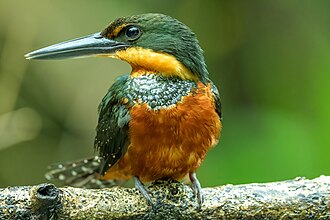
Green-and-rufous Kingfisher
Chloroceryle inda

Belted Kingfisher
Megaceryle alcyon
Global Distribution
Warmer areas are where this animal is recorded most often.
Parks Where Found
Quick answers
What are the chances of seeing a Broad-billed Motmot in Soberanía National Park?
About 40% of wildlife watchers report a Broad-billed Motmot sighting in Soberanía National Park, based on 4,088 verified sightings from GBIF citizen-science data.
When is the best time to see Broad-billed Motmot in Soberanía National Park?
October has the highest sighting rate for Broad-billed Motmot in Soberanía National Park in our monthly data.