
Kentish Plover
Charadrius alexandrinus
- KingdomAnimalia (Animals)
- PhylumChordata (Chordates)
- ClassAves (Birds)
- OrderCharadriiformes (Shorebirds and Allies)
- FamilyCharadriidae (Plovers and Lapwings)
- GenusCharadrius (Holarctic Ringed Plovers and Allies)
- SpeciesCharadrius alexandrinus (Kentish Plover)
About the Kentish Plover
The Kentish plover (Anarhynchus alexandrinus) is a small wader (40–44 g (1.4–1.6 oz)) of the family Charadriidae that breeds on the shores of saline lakes, lagoons, and coasts, populating sand dunes, marshes, semi-arid desert, and tundra. Both male and female birds have pale plumages with a white underside, grey/brown back, dark legs and a dark bill; however, additionally the male birds also exhibit very dark incomplete breast bands, and dark markings either side of their head, therefore the Kentish plover is regarded as sexually dimorphic.
The Kentish plover has a large geographical distribution, ranging from latitudes of 10º to 55º, occupying North Africa, both mainland, such as Senegal, and island, such as the Cape Verde archipelago, Central Asia, for example alkaline lakes in China, and Europe, including small populations in Spain and Austria. Some populations are migratory and often winter in Africa, whereas other populations, such as various island populations, do not migrate. Its common English name comes from the county of Kent, where it was once found, but it has not bred in Britain since 1979.
Kentish plovers are ground-nesting birds, often with a preference for low, open, moist nesting sites away from thick vegetation and human activity. They use a number of materials to build their nests, mainly consisting of shells, pebbles, grass and leaves in a small scrape in the ground. Like most plovers, the Kentish plovers are predominantly insectivores, feeding on a large range of arthropods and invertebrates depending on the environment, by using a run and stop method. Wikipedia →
Closest Relatives at Tangkoko Nature Reserve

Black-bellied Plover
Pluvialis squatarola
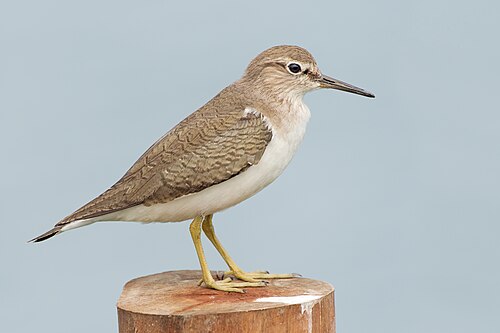
Common Sandpiper
Actitis hypoleucos

Black-naped Tern
Sterna sumatrana

Whiskered Tern
Chlidonias hybrida

Whimbrel
Numenius phaeopus

White-winged Tern
Chlidonias leucopterus

Common Tern
Sterna hirundo

Little Tern
Sternula albifrons

Beach Thick-knee
Esacus magnirostris

Barred Buttonquail
Turnix suscitator

White-headed Stilt
Himantopus leucocephalus

Grey-tailed Tattler
Tringa brevipes
Global Distribution
Where this species is recorded worldwide. Restricted to human observations from 2019 onwards — the same kind of record and the same period the probabilities on this page are built from, so collar-tracking studies, camera-trap arrays and museum specimens are excluded. Around Santa Rosa that removes 5,924 GPS fixes from a handful of tagged jaguars.
where this species is recorded (GBIF density — it tracks where observers go, not how likely a sighting is) · parks where it occurs — tap a pin for the sighting probability there