


Bronzed Drongo
Dicrurus aeneus
- KingdomAnimalia (Animals)
- PhylumChordata (Chordates)
- ClassAves (Birds)
- OrderPasseriformes (Perching Birds)
- FamilyDicruridae (Drongos)
- GenusDicrurus (Drongos)
- SpeciesDicrurus aeneus (Bronzed Drongo)
About the Bronzed Drongo
The bronzed drongo (Dicrurus aeneus) is a small Indomalayan bird belonging to the drongo group. They are resident in the forests of the Indian subcontinent and Southeast Asia. They capture insects flying in the shade of the forest canopy by making aerial sallies from their perches. They are very similar to the other drongos of the region but are somewhat smaller and compact with differences in the fork depth and the patterns of gloss on their feathers.
This drongo is somewhat smaller than the black drongo and has more metallic gloss with a spangled appearance on the head, neck and breast. The lores are velvety and the ear coverts are duller. The tail is slender and well forked with the outer tail feathers flaring outward slightly. Immatures have their axillaries tipped in white. The young bird is duller and brownish with less spangling.
The nominate race is found in India and extending until the northern part of the Malay Peninsula. Specimens from southern India are however very similar in morphometrics to those from malayensis of Burma and the size variation may be clinal. The subspecies from China kwangsiensis is treated as synonymous with aeneus. Subspecies malayensis... Wikipedia →
Closest Relatives at Tanjung Puting National Park

Greater Racket-tailed Drongo
Dicrurus paradiseus

Hair-crested Drongo
Dicrurus hottentottus

Malaysian Pied-Fantail
Rhipidura javanica

Black-and-red Broadbill
Cymbirhynchus macrorhynchos

Olive-winged Bulbul
Pycnonotus plumosus
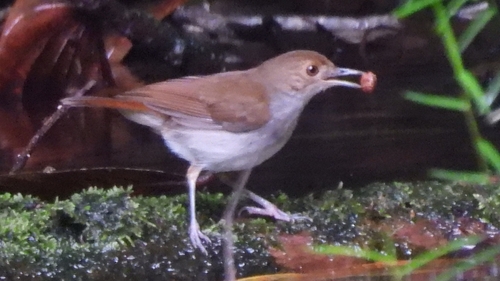
White-chested Babbler
Trichastoma rostratum

Little Spiderhunter
Arachnothera longirostra

Slender-billed Crow
Corvus enca

Van Hasselt's Sunbird
Leptocoma brasiliana

Malaysian Blue-Flycatcher
Cyornis turcosus

Black-winged Flycatcher-shrike
Hemipus hirundinaceus

Green Iora
Aegithina viridissima
Global Distribution
Where this species is recorded worldwide. Restricted to human observations from 2019 onwards — the same kind of record and the same period the probabilities on this page are built from, so collar-tracking studies, camera-trap arrays and museum specimens are excluded. Around Santa Rosa that removes 5,924 GPS fixes from a handful of tagged jaguars.
where this species is recorded (GBIF density — it tracks where observers go, not how likely a sighting is) · parks where it occurs — tap a pin for the sighting probability there