


Common Iora
Aegithina tiphia
- KingdomAnimalia (Animals)
- PhylumChordata (Chordates)
- ClassAves (Birds)
- OrderPasseriformes (Perching Birds)
- FamilyAegithinidae (Ioras)
- GenusAegithina (Ioras)
- SpeciesAegithina tiphia (Common Iora)
About the Common Iora
The common iora (Aegithina tiphia) is a small passerine bird found across the tropical Indian subcontinent and Southeast Asia, with populations showing plumage variations, some of which are designated as subspecies. A species found in scrub and forest, it is easily detected from its loud whistles and the bright colours. During the breeding season, males display by fluffing up their feathers and spiral in the air appearing like a green, black, yellow, and white ball.
In 1747 the English naturalist George Edwards included an illustration and a description of the common iora in the second volume of his A Natural History of Uncommon Birds. He used the English name "The Green Indian Fly-Catcher". Edwards based his hand-coloured etching on a specimen that had been sent from Bengal to the silk-pattern designer and naturalist Joseph Dandridge in London. When in 1758 the Swedish naturalist Carl Linnaeus updated his Systema Naturae for the tenth edition, he placed the common iora in the genus Motacilla. Linnaeus included a brief description, coined the binomial name Motacilla tiphia and cited Edwards' work. The common iora is now placed in the genus Aegithina that was introduced... Wikipedia →
Closest Relatives at Tanjung Puting National Park

Green Iora
Aegithina viridissima

Malaysian Pied-Fantail
Rhipidura javanica

Black-and-red Broadbill
Cymbirhynchus macrorhynchos

Olive-winged Bulbul
Pycnonotus plumosus
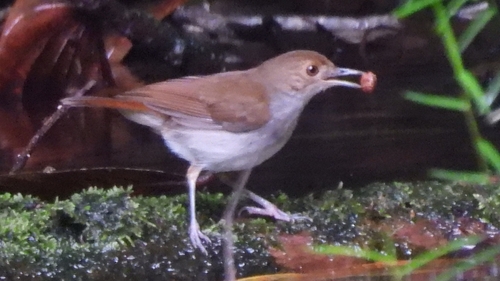
White-chested Babbler
Trichastoma rostratum

Little Spiderhunter
Arachnothera longirostra

Slender-billed Crow
Corvus enca

Van Hasselt's Sunbird
Leptocoma brasiliana

Malaysian Blue-Flycatcher
Cyornis turcosus

Greater Racket-tailed Drongo
Dicrurus paradiseus

Black-winged Flycatcher-shrike
Hemipus hirundinaceus

Fiery Minivet
Pericrocotus igneus
Global Distribution
Where this species is recorded worldwide. Restricted to human observations from 2019 onwards — the same kind of record and the same period the probabilities on this page are built from, so collar-tracking studies, camera-trap arrays and museum specimens are excluded. Around Santa Rosa that removes 5,924 GPS fixes from a handful of tagged jaguars.
where this species is recorded (GBIF density — it tracks where observers go, not how likely a sighting is) · parks where it occurs — tap a pin for the sighting probability there