


Crimson Sunbird
Aethopyga siparaja
- KingdomAnimalia (Animals)
- PhylumChordata (Chordates)
- ClassAves (Birds)
- OrderPasseriformes (Perching Birds)
- FamilyNectariniidae (Sunbirds and Spiderhunters)
- GenusAethopyga (Red Sunbirds and Allies)
- SpeciesAethopyga siparaja (Crimson Sunbird)
About the Crimson Sunbird
The crimson sunbird (Aethopyga siparaja) is a species of bird in the sunbird family which feed largely on nectar. They may also take insects, especially when feeding their young. Flight is fast and direct on their short wings. Most species can take nectar by hovering like a hummingbird, but usually perch to feed. It is the unofficial national bird of Singapore, as declared by the Nature Society Singapore.
Crimson sunbirds are tiny, only 11 cm long. They have medium-length thin down-curved bills and brush-tipped tubular tongues, both adaptations to their nectar feeding. The adult male has a crimson breast and maroon back, with black malar stripes. The rump is yellow and the belly is olive. The female has an olive-green back, yellowish breast and white tips to the outer tail feathers. In most of the range, males have a long green-blue tail, but A.s. nicobarica of the Nicobar Islands and the former subspecies A. vigorsii (Western crimson sunbird) of the Western Ghats of India lack the long central tail feathers. Their call is chee-cheewee.
The crimson sunbird is a resident breeder in tropical southern Asia from India, through Nepal, Pakistan... Wikipedia →
Closest Relatives at Tanjung Puting National Park

Little Spiderhunter
Arachnothera longirostra

Van Hasselt's Sunbird
Leptocoma brasiliana

Ruby-cheeked Sunbird
Chalcoparia singalensis

Copper-throated Sunbird
Leptocoma calcostetha

Brown-throated Sunbird
Anthreptes malacensis

Long-billed Spiderhunter
Arachnothera robusta

Spectacled Spiderhunter
Arachnothera flavigaster

Plain Sunbird
Anthreptes simplex

Malaysian Pied-Fantail
Rhipidura javanica

Black-and-red Broadbill
Cymbirhynchus macrorhynchos

Olive-winged Bulbul
Pycnonotus plumosus
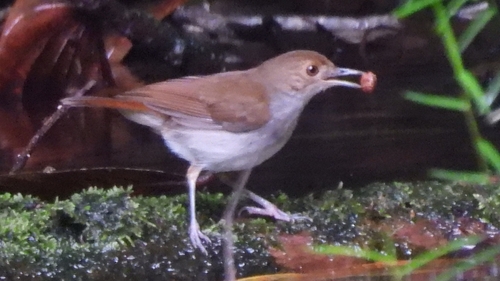
White-chested Babbler
Trichastoma rostratum
Global Distribution
Where this species is recorded worldwide. Restricted to human observations from 2019 onwards — the same kind of record and the same period the probabilities on this page are built from, so collar-tracking studies, camera-trap arrays and museum specimens are excluded. Around Santa Rosa that removes 5,924 GPS fixes from a handful of tagged jaguars.
where this species is recorded (GBIF density — it tracks where observers go, not how likely a sighting is) · parks where it occurs — tap a pin for the sighting probability there