
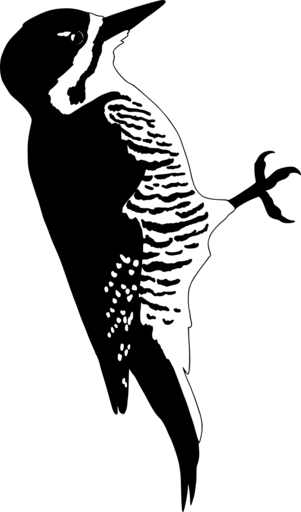
Black-backed Woodpecker
Picoides arcticus
Silhouette: Richard Rich · PhyloPic
- KingdomAnimalia (Animals)
- PhylumChordata (Chordates)
- ClassAves (Birds)
- OrderPiciformes (Woodpeckers and Allies)
- FamilyPicidae (Woodpeckers)
- GenusPicoides (Three-toed Woodpeckers)
- SpeciesPicoides arcticus (Black-backed Woodpecker)
About the Black-backed Woodpecker
The black-backed woodpecker (Picoides arcticus), also known as the Arctic three-toed woodpecker, is a medium-sized woodpecker (23 cm (9.1 in) long) inhabiting the forests of North America. The black-backed woodpecker was described and illustrated by the English naturalist William Swainson in 1832 from a specimen collected near the source of the Athabasca River on the eastern slopes of the Rocky Mountains in Alberta, Canada. He coined the binomial name Picus arcticus. The specific epithet arcticus is the Latin word for "northern" or "arctic". The
black-backed woodpecker is now placed in the genus Picoides which was erected by the French naturalist Bernard Germain de Lacépède in 1799. The species is monotypic: no subspecies are recognised. The plumage of adults is black on the head, back, wings and rump. They are white from the throat to the belly; the flanks are white with black bars. Their tail is black with white outer feathers. There is an element of sexual dimorphism in the plumage, with the adult male possessing a yellow cap. Unlike all other true woodpeckers except the related American and Eurasian three-toed woodpeckers, this species has three... Wikipedia →
Recent sightings of Black-backed Woodpecker in Voyageurs National Park
LIVEiNaturalistClosest Relatives at Voyageurs National Park

 Northern Flicker
Colaptes auratus

 Hairy Woodpecker
Leuconotopicus villosus

 Yellow-bellied Sapsucker
Sphyrapicus varius

 Pileated Woodpecker
Dryocopus pileatus

 Downy Woodpecker
Dryobates pubescens

 Red-bellied Woodpecker
Melanerpes carolinus

 Red-headed Woodpecker
Melanerpes erythrocephalus
Global Distribution
Warmer areas are where this animal is recorded most often.
Parks Where Found
| # | Park | Country | Daily sighting probability |
|---|---|---|---|
| 1 | Yosemite National Park | 🇺🇸 United States | |
| 2 | Isle Royale National Park | 🇺🇸 United States | |
| 3 | Gros Morne National Park | 🇨🇦 Canada | |
| 4 | Cape Breton Highlands National Park | 🇨🇦 Canada | |
| 5 | Denali National Park | 🇺🇸 United States | |
| 6 | Acadia National Park | 🇺🇸 United States | |
| 7 | Wood Buffalo National Park | 🇨🇦 Canada | |
| 8 | Wrangell-St. Elias National Park | 🇺🇸 United States |
Quick answers
What are the chances of seeing a Black-backed Woodpecker in Voyageurs National Park?
Under 5% of wildlife watchers report a Black-backed Woodpecker sighting in Voyageurs National Park, based on 23 verified sightings from GBIF citizen-science data.
When is the best time to see Black-backed Woodpecker in Voyageurs National Park?
February has the highest sighting rate for Black-backed Woodpecker in Voyageurs National Park in our monthly data.