



Red Bishop
Euplectes orix
Silhouette: Sheatherius · PhyloPic
- KingdomAnimalia (Animals)
- PhylumChordata (Chordates)
- ClassAves (Birds)
- OrderPasseriformes (Perching Birds)
- FamilyPloceidae (Weavers and Allies)
- GenusEuplectes (Bishops and Widowbirds)
- SpeciesEuplectes orix (Red Bishop)
About the Red Bishop
The southern red bishop or red bishop (Euplectes orix) is a small passerine bird belonging to the bishop and widowbird genus Euplectes in the weaver family, the Ploceidae. It is common in wetlands and grassland in Africa south of the Equator. North of the Equator, it is replaced by the northern red bishop or orange bishop (E. franciscanus) which was formerly regarded as a subspecies of this species.
In 1751 the English naturalist George Edwards included an illustration and a description of the southern red bishop in the fourth volume of his A Natural History of Uncommon Birds. He used the English name "The Grenadier". Edwards based his hand-coloured etching on a live bird kept at the home of George Shelvocke in Greenwich. Edwards was told that the bird had come from Angola. When in 1758 the Swedish naturalist Carl Linnaeus updated his Systema Naturae for the tenth edition, he placed the southern red bishop with the buntings in the genus Emberiza. Linnaeus included a brief description, coined the binomial name Emberiza orix and cited Edwards' work. The southern red bishop is now one of 17 species placed in the genus Euplectes that was introduced in 1829 by the English... Wikipedia →
Recent sightings of Red Bishop in Akagera National Park
LIVEiNaturalistClosest Relatives at Akagera National Park

 Fan-tailed Widowbird
Euplectes axillaris

White-winged Widowbird
Euplectes albonotatus

Yellow-rumped Widowbird
Euplectes capensis

Black-winged Bishop
Euplectes hordeaceus
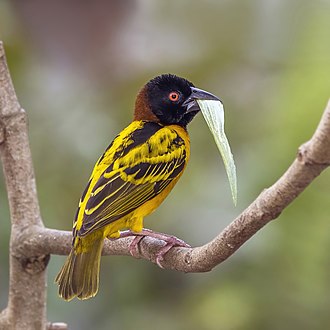
Village Weaver
Ploceus cucullatus

Red-billed Quelea
Quelea quelea

Red-headed Weaver
Anaplectes rubriceps

Holub's Golden-Weaver
Ploceus xanthops

Black-headed Weaver
Ploceus melanocephalus

Lesser Masked-Weaver
Ploceus intermedius

Baglafecht Weaver
Ploceus baglafecht

Grosbeak Weaver
Amblyospiza albifrons
Global Distribution
Warmer areas are where this animal is recorded most often.
Parks Where Found
Quick answers
What are the chances of seeing a Red Bishop in Akagera National Park?
Under 5% of wildlife watchers report a Red Bishop sighting in Akagera National Park, based on 29 verified sightings from GBIF citizen-science data.
When is the best time to see Red Bishop in Akagera National Park?
March has the highest sighting rate for Red Bishop in Akagera National Park in our monthly data.