


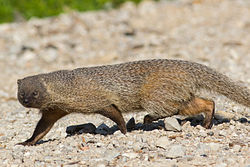

Egyptian Mongoose
Herpestes ichneumon
Silhouette: Margot Michaud · PhyloPic
- KingdomAnimalia (Animals)
- PhylumChordata (Chordates)
- ClassMammalia (Mammals)
- OrderCarnivora (Carnivorans)
- FamilyHerpestidae (Mongooses)
- GenusHerpestes (Slender Mongooses)
- SpeciesHerpestes ichneumon (Egyptian Mongoose)
About the Egyptian Mongoose
The Egyptian mongoose (Herpestes ichneumon), also known as ichneumon, is a mongoose species native to the tropical and subtropical grasslands, savannas, and shrublands of Africa and around the Mediterranean Basin in North Africa, the Middle East and the Iberian Peninsula. Whether it is introduced or native to the Iberian Peninsula is in some doubt. Because of its widespread occurrence, it is listed as Least Concern on the IUCN Red List.
The Egyptian mongoose's long, coarse fur is grey to reddish brown and ticked with brown and yellow flecks. Its snout is pointed, its ears are small. Its slender body is 48–60 cm (1 ft 7 in – 2 ft 0 in) long with a 33–54 cm (1 ft 1 in – 1 ft 9 in) long black tipped tail. Its hind feet and a small area around the eyes are furless. It has 35–40 teeth, with highly developed carnassials, used for shearing meat. It weighs 1.7–4 kg (3.7–8.8 lb).
Sexually dimorphic Egyptian mongooses were observed in Portugal, where some females are smaller than males. Female Egyptian mongooses have 44 chromosomes, and males 43, as one Y chromosome is translocated to an autosome.
The Egyptian mongoose lives in swampy and... Wikipedia →
Recent sightings of Egyptian Mongoose in Amboseli National Park
LIVEiNaturalistClosest Relatives at Amboseli National Park

 Banded Mongoose
Mungos mungo

 Common Dwarf Mongoose
Helogale parvula

 White-tailed Mongoose
Ichneumia albicauda

 Slender Mongoose
Galerella sanguinea

 Spotted Hyena
Crocuta crocuta

 Lion
Panthera leo

 Cheetah
Acinonyx jubatus

 Serval
Leptailurus serval

 Bat-eared Fox
Otocyon megalotis

 African Golden Wolf
Canis lupaster

 African Civet
Civettictis civetta

 Leopard
Panthera pardus
Global Distribution
Warmer areas are where this animal is recorded most often.
Parks Where Found
| # | Park | Country | Daily sighting probability |
|---|---|---|---|
| 1 | Monfragüe National Park | 🇪🇸 Spain | |
| 2 | Amboseli National Park | 🇰🇪 Kenya | |
| 3 | Doñana National Park | 🇪🇸 Spain | |
| 4 | Garden Route National Park | 🇿🇦 South Africa | |
| 5 | Niokolo-Koba National Park | 🇸🇳 Senegal | |
| 6 | Meru National Park | 🇰🇪 Kenya | |
| 7 | Ruaha National Park | 🇹🇿 Tanzania | |
| 8 | Gorongosa National Park | 🇲🇿 Mozambique | |
| 9 | Kibale National Park | 🇺🇬 Uganda | |
| 10 | Queen Elizabeth National Park | 🇺🇬 Uganda | |
| 11 | Nairobi National Park | 🇰🇪 Kenya | |
| 12 | Ngorongoro Conservation Area | 🇹🇿 Tanzania | |
| 13 | Tsavo East National Park | 🇰🇪 Kenya | |
| 14 | Serengeti National Park | 🇹🇿 Tanzania | |
| 15 | Masai Mara National Reserve | 🇰🇪 Kenya | |
| 16 | Sierra de Guadarrama National Park | 🇪🇸 Spain | |
| 17 | Table Mountain National Park | 🇿🇦 South Africa |
Quick answers
What are the chances of seeing a Egyptian Mongoose in Amboseli National Park?
About 10% of wildlife watchers report a Egyptian Mongoose sighting in Amboseli National Park, based on 5 verified sightings from GBIF citizen-science data.
When is the best time to see Egyptian Mongoose in Amboseli National Park?
December has the highest sighting rate for Egyptian Mongoose in Amboseli National Park in our monthly data.