

White-eyed Parakeet
Aratinga leucophthalma
Silhouette: Myriam_Ramirez · PhyloPic
- KingdomAnimalia (Animals)
- PhylumChordata (Chordates)
- ClassAves (Birds)
- OrderPsittaciformes (Parrots)
- FamilyPsittacidae (New World and African Parrots)
- GenusAratinga (Aratinga Parakeets)
- SpeciesAratinga leucophthalma (White-eyed Parakeet)
About the White-eyed Parakeet
The white-eyed parakeet (Psittacara leucophthalmus), known in aviculture as white-eyed conure, is a species of bird in the subfamily Arinae of the family Psittacidae, the African and New World parrots. It is found in every mainland South American country except Chile and also on Trinidad.
The white-eyed parakeet was for a time placed in the genus Aratinga but from about 2013 has been in its present genus Psittacara. It has these three subspecies: P. l. callogenys (Salvadori, 1891) P. l. leucophthalmus (Müller, P.L.S., 1776)
P. l. nicefori (Meyer de Schauensee, 1946) What is now Finsch's parakeet (P. finschi) was for a time treated as a fourth subspecies of white-eyed parakeet, and they now constitute a superspecies. The white-eyed parakeet's specific epithet is derived from the Ancient Greek leukos "white" and ophthalmos "eye".
The white-eyed parakeet is 32 to 35 cm (13 to 14 in) long with a 37 to 40 cm (15 to 16 in) wingspan. It weighs 100 to 218 g (3.5 to 7.7 oz). The sexes are alike. Adults of all subspecies are mostly green that is paler on their underparts. They have red flecks on their head and neck. The bend and edge of their... Wikipedia →
Recent sightings of White-eyed Parakeet in Chapada Diamantina National Park
LIVEiNaturalistClosest Relatives at Chapada Diamantina National Park

 Cactus Parakeet
Aratinga cactorum

Peach-fronted Parakeet
Aratinga aurea

 Maroon-bellied Parakeet
Pyrrhura frontalis

Blue-winged Parrotlet
Forpus xanthopterygius
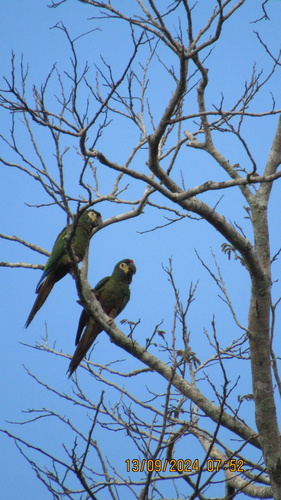
Blue-winged Macaw
Primolius maracana

Scaly-headed Parrot
Pionus maximiliani

 Yellow-chevroned Parakeet
Brotogeris chiriri

Red-shouldered Macaw
Diopsittaca nobilis

Plain Parakeet
Brotogeris tirica
Global Distribution
Warmer areas are where this animal is recorded most often.