
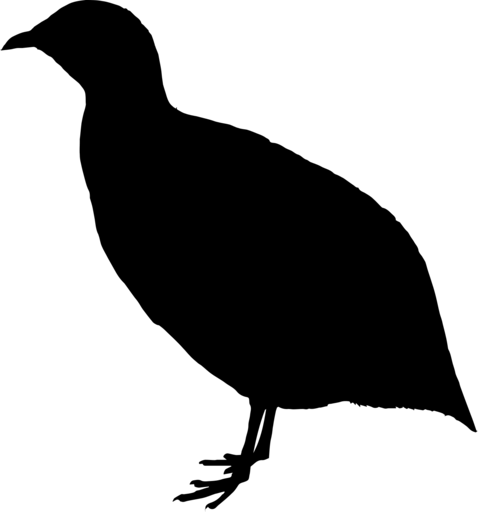
Common Buttonquail
Turnix sylvaticus
Silhouette: PhyloPic · PhyloPic
- KingdomAnimalia (Animals)
- PhylumChordata (Chordates)
- ClassAves (Birds)
- OrderCharadriiformes (Shorebirds and Allies)
- FamilyTurnicidae (Buttonquails)
- GenusTurnix (Buttonquail)
- SpeciesTurnix sylvaticus (Common Buttonquail)
About the Common Buttonquail
The common buttonquail (Turnix sylvaticus), also called Kurrichane buttonquail and Andalusian hemipode, is a buttonquail, one of a small family of birds that resemble but are not closely related to the true quails. The common buttonquail was formally described and illustrated in 1789 by the French botanist René Louiche Desfontaines under the binomial name Tetrao sylvaticus. The specific epithet sylvaticus is Latin meaning "of the woods". It is now placed in the genus Turnix that was named in 1840 by Pierre Joseph Bonnaterre.
Nine subspecies are recognised: T. s. sylvaticus (Desfontaines, 1789) – the southern Iberian Peninsula and northwestern Africa T. s. lepurana (Smith, A, 1836) – Africa south of the Sahara T. s. dussumier (Temminck, 1828) – eastern Iran to Myanmar
T. s. davidi Delacour & Jabouille, 1930 – central Thailand to southern China, northern Indochina and Taiwan T. s. bartelsorum Neumann, 1929 – Java and Bali, Indonesia T. s. whiteheadi Ogilvie-Grant, 1897 – Luzon, the northern Philippines
T. s. celestinoi McGregor, 1907 – Bohol and Mindanao, the southern Philippines T. s. nigrorum duPont, 1976 – Negros island †T. s. suluensis Mearns, 1905 – the Sulu Archipelago... Wikipedia →
Recent sightings of Common Buttonquail in Chobe National Park
LIVEiNaturalistClosest Relatives at Chobe National Park

 Blacksmith Lapwing
Vanellus armatus

 African Jacana
Actophilornis africanus

White-headed Lapwing
Vanellus albiceps

 Water Thick-knee
Burhinus vermiculatus

 Black-winged Stilt
Himantopus himantopus

 Common Sandpiper
Actitis hypoleucos

Long-toed Lapwing
Vanellus crassirostris

 Collared Pratincole
Glareola pratincola

 Whiskered Tern
Chlidonias hybrida

 African Skimmer
Rynchops flavirostris

 Wood Sandpiper
Tringa glareola

 Grey-hooded Gull
Chroicocephalus cirrocephalus
Global Distribution
Warmer areas are where this animal is recorded most often.
Parks Where Found
Quick answers
What are the chances of seeing a Common Buttonquail in Chobe National Park?
Under 5% of wildlife watchers report a Common Buttonquail sighting in Chobe National Park, based on 9 verified sightings from GBIF citizen-science data.
When is the best time to see Common Buttonquail in Chobe National Park?
February has the highest sighting rate for Common Buttonquail in Chobe National Park in our monthly data.