
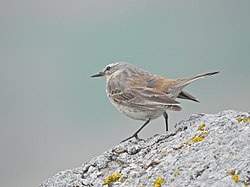


Water Pipit
Anthus spinoletta
Silhouette: Susan Murphy (original photograph), T. Michael Keesey (vectorization) · PhyloPic
- KingdomAnimalia (Animals)
- PhylumChordata (Chordates)
- ClassAves (Birds)
- OrderPasseriformes (Perching Birds)
- FamilyMotacillidae (Wagtails and Pipits)
- GenusAnthus (Pipits)
- SpeciesAnthus spinoletta (Water Pipit)
About the Water Pipit
The water pipit (Anthus spinoletta) is a small passerine bird which breeds in the mountains of Southern Europe and the Palearctic eastwards to China. It is a short-distance migrant; many birds move to lower altitudes or wet open lowlands in winter.
The water pipit in breeding plumage has greyish-brown upperparts, weakly streaked with darker brown, and pale pink-buff underparts fading to whitish on the lower belly. The head is grey with a broad white supercilium ("eyebrow"), and the outer tail feathers are white. In winter, the head is grey-brown, the supercilium is duller, the upperparts are more streaked, and the underparts are white, streaked lightly with brown on the breast and flanks. There are only minor differences among the three subspecies, the sexes are almost identical, and young birds resemble adults. The water pipit's song is delivered from a perch or in flight, and consists of four or five blocks, each consisting of about six repetitions of a different short note.
Water pipits construct a cup-like nest on the ground under vegetation or in cliff crevices and lay four to six speckled grey-ish white eggs, which hatch in about two weeks with a further 14–15 days to fledging. Although pipits occasionally catch insects in flight, they feed mainly on small invertebrates picked off the ground or vegetation, and also some plant material.
The water pipit may be hunted by birds of prey, infested by parasites such as fleas, or act as an involuntary host to the common cuckoo, but overall its population is large and stable, and it is therefore evaluated as a species of least concern by the International Union for Conservation of Nature (IUCN). Wikipedia →
Recent sightings of Water Pipit in Gobi Gurvansaikhan National Park
LIVEiNaturalistClosest Relatives at Gobi Gurvansaikhan National Park

 Rosy Pipit
Anthus roseatus

Blyth's Pipit
Anthus godlewskii

Richard's Pipit
Anthus richardi

Olive-backed Pipit
Anthus hodgsoni

 Tree Pipit
Anthus trivialis

 Grey Wagtail
Motacilla cinerea

Citrine Wagtail
Motacilla citreola

White Wagtail
Motacilla alba

Eastern Yellow Wagtail
Motacilla tschutschensis

Western Yellow Wagtail
Motacilla flava

 Forest Wagtail
Dendronanthus indicus

 Horned Lark
Eremophila alpestris
Global Distribution
Warmer areas are where this animal is recorded most often.
Parks Where Found
| # | Park | Country | Daily sighting probability |
|---|---|---|---|
| 1 | Hohe Tauern National Park | 🇦🇹 Austria | |
| 2 | Picos de Europa National Park | 🇪🇸 Spain | |
| 3 | Vanoise National Park | 🇫🇷 France | |
| 4 | Aigüestortes National Park | 🇪🇸 Spain | |
| 5 | Mercantour National Park | 🇫🇷 France | |
| 6 | Ordesa y Monte Perdido National Park | 🇪🇸 Spain | |
| 7 | Tatra National Park | 🇸🇰 Slovakia | |
| 8 | Pyrénées National Park | 🇫🇷 France | |
| 9 | Ecrins National Park | 🇫🇷 France | |
| 10 | Triglav National Park | 🇸🇮 Slovenia | |
| 11 | Kiskunság National Park | 🇭🇺 Hungary | |
| 12 | Hortobágy National Park | 🇭🇺 Hungary | |
| 13 | Sierra de Guadarrama National Park | 🇪🇸 Spain | |
| 14 | Gobi Gurvansaikhan National Park | 🇲🇳 Mongolia | |
| 15 | Sierra Nevada National Park | 🇪🇸 Spain | |
| 16 | Monfragüe National Park | 🇪🇸 Spain | |
| 17 | Fertő-Hanság National Park | 🇭🇺 Hungary | |
| 18 | Camargue | 🇫🇷 France | |
| 19 | Bavarian Forest National Park | 🇩🇪 Germany | |
| 20 | Wadden Sea National Park | 🇩🇪 Germany | |
| 21 | Doñana National Park | 🇪🇸 Spain | |
| 22 | Snowdonia National Park | 🇬🇧 United Kingdom | |
| 23 | Cévennes National Park | 🇫🇷 France | |
| 24 | Chitwan National Park | 🇳🇵 Nepal |
Quick answers
What are the chances of seeing a Water Pipit in Gobi Gurvansaikhan National Park?
Under 5% of wildlife watchers report a Water Pipit sighting in Gobi Gurvansaikhan National Park, based on 62 verified sightings from GBIF citizen-science data.
When is the best time to see Water Pipit in Gobi Gurvansaikhan National Park?
December has the highest sighting rate for Water Pipit in Gobi Gurvansaikhan National Park in our monthly data.