


House Swift
Apus nipalensis
- KingdomAnimalia (Animals)
- PhylumChordata (Chordates)
- ClassAves (Birds)
- OrderApodiformes (Swifts and Hummingbirds)
- FamilyApodidae (Swifts)
- GenusApus (Typical Swifts)
- SpeciesApus nipalensis (House Swift)
About the House Swift
The house swift (Apus nipalensis) is a species of swift in the family Apodidae. It is found in Japan, Nepal, and Southeast Asia. It is capable of flying long distances by alternately shutting off hemispheres of its brain in-flight.
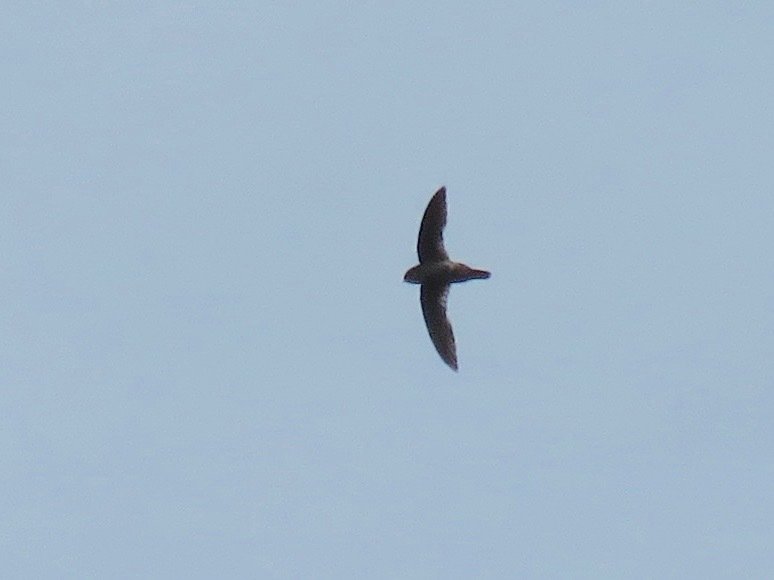
It was formerly considered a subspecies of the little swift, under the name Apus affinis subfurcatus. The house swift looks quite similar to the little swift. It is a small bird, but a medium-sized swift, with a wingspan of 12.5-14.5 cm. Its body size ranges from 14 to 16 cm and weighs approximately 20-35 g. This species has a dark, slightly forked tail. Other than the white rump band and white throat-patch, the house swift has a black plumage, darker than the little swift.
The name Apus nipalensis has two parts. Apus is the genus for swifts, and comes from the Latin word for the swift, or swallow with no feet. Nipalensis means from Nepal. Currently, there are four subspecies of the house swift: Apus nipalensis nipalensis, Apus nipalensis subfurcatus, Apus nipalensis furcatus, and Apus nipalensis kuntzi.
The house swift is highly aerial, spending much of its time feeding in the air. The house... Wikipedia →
Closest Relatives at Gunung Leuser National Park

Pacific Swift
Apus pacificus

Plume-toed Swiftlet
Collocalia affinis

Black-nest Swiftlet
Aerodramus maximus

Silver-rumped Needletail
Rhaphidura leucopygialis

White-nest Swiftlet
Aerodramus fuciphagus
Waterfall Swift
Hydrochous gigas

Brown-backed Needletail
Hirundapus giganteus

Asian Palm-Swift
Cypsiurus balasiensis

Mossy-nest Swiftlet
Aerodramus salangana

White-throated Needletail
Hirundapus caudacutus

Silver-backed Needletail
Hirundapus cochinchinensis

Gray-rumped Treeswift
Hemiprocne longipennis
Global Distribution
Where this species is recorded worldwide. Restricted to human observations from 2019 onwards — the same kind of record and the same period the probabilities on this page are built from, so collar-tracking studies, camera-trap arrays and museum specimens are excluded. Around Santa Rosa that removes 5,924 GPS fixes from a handful of tagged jaguars.
where this species is recorded (GBIF density — it tracks where observers go, not how likely a sighting is) · parks where it occurs — tap a pin for the sighting probability there