


Mutilating Gecko
Gehyra mutilata
- KingdomAnimalia (Animals)
- PhylumChordata (Chordates)
- ClassSquamata
- FamilyGekkonidae (Typical Geckos)
- GenusGehyra (Dtellas)
- SpeciesGehyra mutilata (Mutilating Gecko)
About the Mutilating Gecko
Gehyra mutilata, also known commonly as the common four-clawed gecko, Pacific gecko, stump-toed gecko, sugar gecko in Indonesia, tender-skinned house gecko, and butiki in Filipino, is a species of lizard in the family Gekkonidae. The species is native to Southeast Asia. It has made its way to several areas of the world including Sri Lanka, Indochina, and many of the Pacific Islands. Compared to the common house gecko (Hemidactylus frenatus), the appearance of G. mutilata is somewhat plump, with delicate skin. The skin is usually colored a soft purplish/pinkish gray, with golden spots on younger specimens; these spots eventually fade with age.
The head of G. mutilata is longer than broad. The snout is longer than the distance between the eye and the ear-opening, about 1.3 times the diameter of the orbit. The forehead has a median groove. The ear-opening is moderately large and suboval. The body and limbs are moderately elongate and depressed. A fold of the skin borders the hind limb posteriorly. The digits are short and more or less webbed at the base. The inferior lamellae are angular and divided by a median groove. The upper surface of the body and the throat are... Wikipedia →
Closest Relatives at Gunung Leuser National Park

Flat-tailed House Gecko
Hemidactylus platyurus

Spotted House Gecko
Gekko monarchus

Large Forest Gecko
Gekko smithii

Common House Gecko
Hemidactylus frenatus

Gliding gecko
Gekko kuhli

Four-striped Forest Gecko
Cyrtodactylus quadrivirgatus

Marbled Bow-fingered Gecko
Cyrtodactylus marmoratus
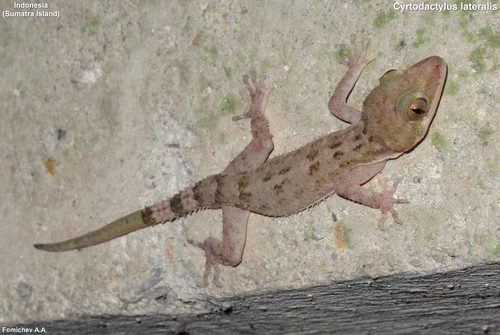
Spiny Forest Gecko
Cyrtodactylus lateralis
Brooks' Wolf Gecko
Luperosaurus brooksii
Global Distribution
Where this species is recorded worldwide. Restricted to human observations from 2019 onwards — the same kind of record and the same period the probabilities on this page are built from, so collar-tracking studies, camera-trap arrays and museum specimens are excluded. Around Santa Rosa that removes 5,924 GPS fixes from a handful of tagged jaguars.
where this species is recorded (GBIF density — it tracks where observers go, not how likely a sighting is) · parks where it occurs — tap a pin for the sighting probability there
Parks Where Found
| # | Park | Country | Daily sighting probability |
|---|---|---|---|
| 1 | Ranomafana National Park | 🇲🇬 Madagascar | |
| 2 | Sinharaja Forest Reserve | 🇱🇰 Sri Lanka | |
| 3 | Khao Luang National Park | 🇹🇭 Thailand | |
| 4 | Cat Tien National Park | 🇻🇳 Vietnam | |
| 5 | Kinabatangan Wildlife Sanctuary | 🇲🇾 Malaysia | |
| 6 | Danum Valley Conservation Area | 🇲🇾 Malaysia | |
| 7 | Khao Sok National Park | 🇹🇭 Thailand | |
| 8 | Yala National Park | 🇱🇰 Sri Lanka | |
| 9 | Kinabalu Park | 🇲🇾 Malaysia | |
| 10 | Kaeng Krachan National Park | 🇹🇭 Thailand | |
| 11 | Sepilok | 🇲🇾 Malaysia | |
| 12 | Khao Yai National Park | 🇹🇭 Thailand | |
| 13 | Periyar National Park | 🇮🇳 India | |
| 14 | Kerinci Seblat National Park | 🇮🇩 Indonesia | |
| 15 | Bako National Park | 🇲🇾 Malaysia | |
| 16 | Tanjung Puting National Park | 🇮🇩 Indonesia | |
| 17 | Gunung Leuser National Park | 🇮🇩 Indonesia | |
| 18 | Bali Barat National Park | 🇮🇩 Indonesia | |
| 19 | Doi Inthanon National Park | 🇹🇭 Thailand | |
| 20 | Taman Negara National Park | 🇲🇾 Malaysia | |
| 21 | Cañón del Sumidero National Park | 🇲🇽 Mexico |