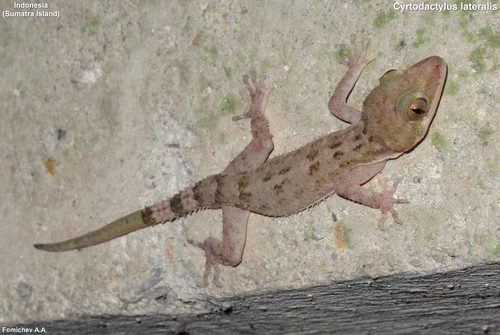
Common House Gecko

Common House Gecko

Hemidactylus frenatus

Least ConcernNear ThreatenedVulnerableEndangeredCritically Endangered Endemic
Daily sighting probability ~20% · Possible
at Gunung Leuser National Park
12 Verified sightings at Gunung Leuser National Park From 2019 to 2026
1,793 Verified sightings across all 103 parks From 2019 to 2026
June Best month highest sighting rate
☀️🌙 Day & Night When it's spotted Active throughout day and night

About the Common House Gecko

The Common house gecko (Hemidactylus frenatus) is a gecko native to South and Southeast Asia and Near Oceania. It is also known as the Asian house gecko, Pacific house gecko, wall gecko, House lizard, Tiktiki, chipkali and moon lizard.

The common house gecko is nocturnal, hiding during the day and foraging for insects at night. They can be seen climbing walls of houses and other buildings in search of insects attracted to porch lights, and are immediately recognisable by their characteristic chirping.

They grow to a length of between 7.5–15 cm (3–6 in), and live for about 7 years. They are non-venomous and not harmful to humans. Most medium-sized to large geckos are docile, but may bite if distressed, which might pierce skin. The common house gecko is a tropical species, and thrives in warm, humid areas where it can crawl around on rotting wood in search of the insects it eats, as well as within urban landscapes in warm climates. The animal is very adaptable and may prey on insects and spiders, displacing other gecko species which are less robust or behaviourally aggressive. In parts of Australia and Papua New Guinea they are often confused with a similar native lizard, the dubious dtella. Wikipedia →

Global Distribution

Where this species is recorded worldwide. Restricted to human observations from 2019 onwards — the same kind of record and the same period the probabilities on this page are built from, so collar-tracking studies, camera-trap arrays and museum specimens are excluded. Around Santa Rosa that removes 5,924 GPS fixes from a handful of tagged jaguars.

where this species is recorded (GBIF density — it tracks where observers go, not how likely a sighting is)  ·  parks where it occurs — tap a pin for the sighting probability there

Parks Where Found

# Park Country Daily sighting probability
1 Tayrona National Natural Park 🇨🇴 Colombia
~50%
2 Taroko National Park 🇹🇼 Taiwan
~50%
3 Ankarafantsika National Park 🇲🇬 Madagascar
~40%
4 Main Ridge Forest Reserve 🇹🇹 Trinidad and Tobago
~40%
5 Cabo Pulmo National Park 🇲🇽 Mexico
~40%
6 Cuc Phuong National Park 🇻🇳 Vietnam
~40%
7 Wilpattu National Park 🇱🇰 Sri Lanka
~40%
8 Daintree National Park 🇦🇺 Australia
~40%
9 Palo Verde National Park 🇨🇷 Costa Rica
~30%
10 Khao Luang National Park 🇹🇭 Thailand
~30%
11 Kerinci Seblat National Park 🇮🇩 Indonesia
~30%
12 Ría Lagartos Biosphere Reserve 🇲🇽 Mexico
~30%
13 Ostional Wildlife Refuge 🇨🇷 Costa Rica
~30%
14 Khao Sok National Park 🇹🇭 Thailand
~30%
15 Cat Tien National Park 🇻🇳 Vietnam
~30%
16 Las Baulas Marine National Park 🇨🇷 Costa Rica
~30%
17 Kinabalu Park 🇲🇾 Malaysia
~30%
18 Danum Valley Conservation Area 🇲🇾 Malaysia
~30%
19 Machalilla National Park 🇪🇨 Ecuador
~30%
20 Tenorio Volcano National Park 🇨🇷 Costa Rica
~30%
21 Soberanía National Park 🇵🇦 Panama
~30%
22 Raja Ampat 🇮🇩 Indonesia
~30%
23 Marino Ballena National Park 🇨🇷 Costa Rica
~30%
24 Cabo Blanco Absolute Nature Reserve 🇨🇷 Costa Rica
~30%
25 Biotopo Cerro Cahuí 🇬🇹 Guatemala
~30%
26 Tangkoko Nature Reserve 🇮🇩 Indonesia
~30%
27 Bahía de Loreto National Park 🇲🇽 Mexico
~30%
28 Kakadu National Park 🇦🇺 Australia
~30%
29 Ningaloo Marine Park 🇦🇺 Australia
~20%
30 Henri Pittier National Park 🇻🇪 Venezuela
~20%
31 Manuel Antonio National Park 🇨🇷 Costa Rica
~20%
32 Santa Rosa National Park 🇨🇷 Costa Rica
~20%
33 Kaeng Krachan National Park 🇹🇭 Thailand
~20%
34 Khao Yai National Park 🇹🇭 Thailand
~20%
35 Arenal Volcano National Park 🇨🇷 Costa Rica
~20%
36 Gandoca-Manzanillo Wildlife Refuge 🇨🇷 Costa Rica
~20%
37 Celestún Biosphere Reserve 🇲🇽 Mexico
~20%
38 Carara National Park 🇨🇷 Costa Rica
~20%
39 Calakmul Biosphere Reserve 🇲🇽 Mexico
~20%
40 Tortuguero National Park 🇨🇷 Costa Rica
~20%
41 Rincón de la Vieja National Park 🇨🇷 Costa Rica
~20%
42 Masaya Volcano National Park 🇳🇮 Nicaragua
~20%
43 Taman Negara National Park 🇲🇾 Malaysia
~20%
44 Minneriya National Park 🇱🇰 Sri Lanka
~20%
45 Gunung Leuser National Park 🇮🇩 Indonesia
~20%
46 Arrecifes de Cozumel National Park 🇲🇽 Mexico
~20%
47 Piedras Blancas National Park 🇨🇷 Costa Rica
~20%
48 Chitwan National Park 🇳🇵 Nepal
~20%
49 Sinharaja Forest Reserve 🇱🇰 Sri Lanka
~20%
50 Cerro Azul Meámbar National Park 🇭🇳 Honduras
~20%
51 Yala National Park 🇱🇰 Sri Lanka
~20%
52 Tikal National Park 🇬🇹 Guatemala
~20%
53 Kinabatangan Wildlife Sanctuary 🇲🇾 Malaysia
~20%
54 Darién National Park 🇵🇦 Panama
~20%
55 Braulio Carrillo National Park 🇨🇷 Costa Rica
~20%
56 Cuyabeno Wildlife Reserve 🇪🇨 Ecuador
~20%
57 Sepilok 🇲🇾 Malaysia
~20%
58 Galápagos Islands 🇪🇨 Ecuador
~20%
59 Yasuní National Park 🇪🇨 Ecuador
~20%
60 Sian Ka'an Biosphere Reserve 🇲🇽 Mexico
~20%
61 Chagres National Park 🇵🇦 Panama
~10%
62 Cañón del Sumidero National Park 🇲🇽 Mexico
~10%
63 Monteverde Cloud Forest Reserve 🇨🇷 Costa Rica
~10%
64 Doi Inthanon National Park 🇹🇭 Thailand
~10%
65 Bastimentos Island National Marine Park 🇵🇦 Panama
~10%
66 La Amistad International Park (Panama) 🇵🇦 Panama
~10%
67 Montes Azules Biosphere Reserve 🇲🇽 Mexico
~10%
68 Corcovado National Park 🇨🇷 Costa Rica
~10%
69 Everglades National Park 🇺🇸 United States
~10%
70 Tapantí-Macizo de la Muerte National Park 🇨🇷 Costa Rica
~10%
71 Caroni Swamp 🇹🇹 Trinidad and Tobago
Insufficient data
72 Pico Bonito National Park 🇭🇳 Honduras
Insufficient data
73 Way Kambas National Park 🇮🇩 Indonesia
Insufficient data
74 Namdapha National Park 🇮🇳 India
Insufficient data
75 Noosa National Park 🇦🇺 Australia
Insufficient data
76 Utría National Natural Park 🇨🇴 Colombia
Insufficient data
77 Litchfield National Park 🇦🇺 Australia
Insufficient data
78 Bali Barat National Park 🇮🇩 Indonesia
Insufficient data
79 Nagarhole National Park 🇮🇳 India
Insufficient data
80 Royal Manas National Park 🇧🇹 Bhutan
Insufficient data
81 Coiba National Park 🇵🇦 Panama
Insufficient data
82 Periyar National Park 🇮🇳 India
Insufficient data
83 Bako National Park 🇲🇾 Malaysia
Insufficient data
84 Cusuco National Park 🇭🇳 Honduras
Insufficient data
85 Bandhavgarh National Park 🇮🇳 India
Insufficient data
86 Celaque National Park 🇭🇳 Honduras
Insufficient data
87 Chirripó National Park 🇨🇷 Costa Rica
Insufficient data
88 Tanjung Puting National Park 🇮🇩 Indonesia
Insufficient data
89 Bandipur National Park 🇮🇳 India
Insufficient data
90 Manas National Park 🇮🇳 India
Insufficient data
91 Sierra de la Macarena National Park 🇨🇴 Colombia
Insufficient data
92 Nitmiluk National Park 🇦🇺 Australia
Insufficient data
93 Anavilhanas National Park 🇧🇷 Brazil
Insufficient data
94 Cape Range 🇦🇺 Australia
Insufficient data
95 Reserva de la Biosfera Mariposa Monarca 🇲🇽 Mexico
Insufficient data
96 Cahuita National Park 🇨🇷 Costa Rica
Insufficient data
97 Springbrook National Park 🇦🇺 Australia
Insufficient data
98 Lago de Yojoa 🇭🇳 Honduras
Insufficient data
99 Farallones de Cali National Natural Park 🇨🇴 Colombia
Insufficient data
100 Lamington National Park 🇦🇺 Australia
Insufficient data
101 Parque Natural Metropolitano 🇵🇦 Panama
Insufficient data
102 Podocarpus National Park 🇪🇨 Ecuador
Insufficient data
103 El Vizcaíno Biosphere Reserve 🇲🇽 Mexico
Insufficient data

Quick answers

What are the chances of seeing a Common House Gecko in Gunung Leuser National Park?

About 20% of wildlife watchers report a Common House Gecko sighting in Gunung Leuser National Park, based on 12 verified sightings from GBIF citizen-science data.

When is the best time to see Common House Gecko in Gunung Leuser National Park?

June has the highest sighting rate for Common House Gecko in Gunung Leuser National Park in our monthly data.

← Back to Gunung Leuser National Park