

Common Mussurana
Clelia clelia
Silhouette: Alex Slavenko · PhyloPic
- KingdomAnimalia (Animals)
- PhylumChordata (Chordates)
- ClassSquamata
- FamilyColubridae (Colubrid Snakes)
- GenusClelia (Mussuranas)
- SpeciesClelia clelia (Common Mussurana)
About the Common Mussurana
Clelia clelia, commonly known as the mussurana, black mussurana or windward cribo, is a species of snake in the subfamily Dipsadinae of the family Colubridae. The species is native to the New World. The subspecific name, groomei, is in honor of Grenadian zoologist John R. Groome.
Clelia clelia is called doi or duma in the Kwaza language of Rondônia, Brazil. Clelia clelia is found in Central America, South America, and the Lesser Antilles (including the island of Trinidad). The preferred natural habitat of Clelia clelia is forest at altitudes from sea level to 1,500 m (4,900 ft).
Clelia clelia is a large snake. Adults may attain a snout-to-vent length (SVL) of 2.1 m (6.9 ft). Dorsally, adults are uniform black, gray, or olive-gray. Ventrally, adults are yellowish white. Juveniles are pale brown or red, with a black head and a yellow collar.
Clelia clelia is terrestrial. It is primarily nocturnal, but it is also sometimes diurnal. Clelia clelia is a generalized noctural predator with a strong degree of ophiophagy, including venomous snakes of the genera Bothriechis, Bothrops... Wikipedia →
Recent sightings of Common Mussurana in La Amistad International Park (Panama)
LIVEiNaturalistClosest Relatives at La Amistad International Park (Panama)

 Blunthead Tree Snake
Imantodes cenchoa
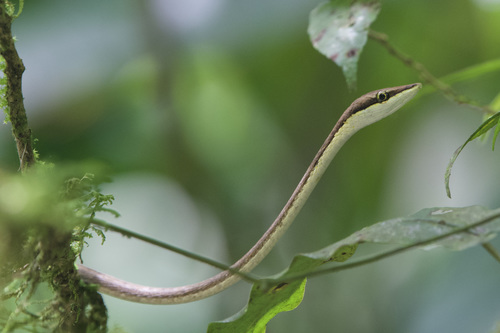
 Striped Vine Snake
Oxybelis vittatus

Chicken Snake
Spilotes pullatus

Puffing Snake
Phrynonax poecilonotus

 South American Milksnake
Lampropeltis micropholis
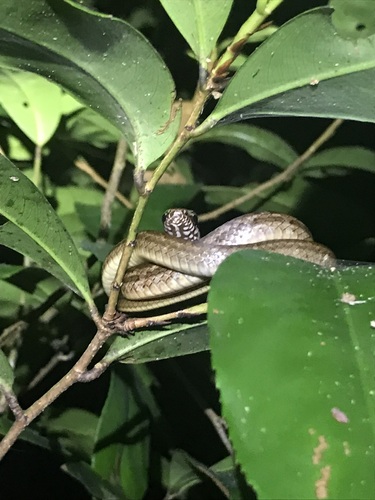
Central American Lizard Eater
Mastigodryas alternatus
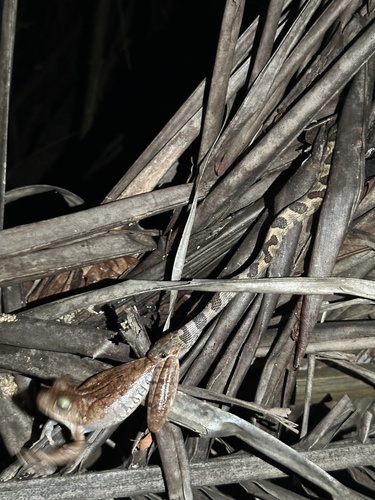
 Ornate Cat-eyed Snake
Leptodeira ornata

Cloudy Snail-eating Snake
Sibon nebulatus

Spotted Coffee Snake
Ninia maculata

 Adorned Graceful Brown Snake
Rhadinaea decorata

Taylor's Snail-eater
Dipsas tenuissima

Fire-bellied Snake
Erythrolamprus epinephalus
Global Distribution
Warmer areas are where this animal is recorded most often.
Parks Where Found
| # | Park | Country | Daily sighting probability |
|---|---|---|---|
| 1 | Tambopata National Reserve | 🇵🇪 Peru | |
| 2 | Arenal Volcano National Park | 🇨🇷 Costa Rica | |
| 3 | Manu National Park | 🇵🇪 Peru | |
| 4 | Corcovado National Park | 🇨🇷 Costa Rica | |
| 5 | La Amistad International Park (Panama) | 🇵🇦 Panama | |
| 6 | Monteverde Cloud Forest Reserve | 🇨🇷 Costa Rica | |
| 7 | Utría National Natural Park | 🇨🇴 Colombia | |
| 8 | Cordillera Azul National Park | 🇵🇪 Peru | |
| 9 | Coiba National Park | 🇵🇦 Panama | |
| 10 | Piedras Blancas National Park | 🇨🇷 Costa Rica | |
| 11 | Rincón de la Vieja National Park | 🇨🇷 Costa Rica | |
| 12 | Bastimentos Island National Marine Park | 🇵🇦 Panama | |
| 13 | Cerro Azul Meámbar National Park | 🇭🇳 Honduras | |
| 14 | Volcán Barú National Park | 🇵🇦 Panama | |
| 15 | Chagres National Park | 🇵🇦 Panama | |
| 16 | Podocarpus National Park | 🇪🇨 Ecuador | |
| 17 | Darién National Park | 🇵🇦 Panama | |
| 18 | Gandoca-Manzanillo Wildlife Refuge | 🇨🇷 Costa Rica | |
| 19 | Chirripó National Park | 🇨🇷 Costa Rica | |
| 20 | Farallones de Cali National Natural Park | 🇨🇴 Colombia |
Quick answers
What are the chances of seeing a Common Mussurana in La Amistad International Park (Panama)?
About 10% of wildlife watchers report a Common Mussurana sighting in La Amistad International Park (Panama), based on 13 verified sightings from GBIF citizen-science data.
When is the best time to see Common Mussurana in La Amistad International Park (Panama)?
June has the highest sighting rate for Common Mussurana in La Amistad International Park (Panama) in our monthly data.