

Sooty Shearwater
Puffinus griseus
Silhouette: Juan Carlos Jerí · PhyloPic
- KingdomAnimalia (Animals)
- PhylumChordata (Chordates)
- ClassAves (Birds)
- OrderProcellariiformes (Tubenoses)
- FamilyProcellariidae (Shearwaters and Petrels)
- GenusPuffinus (Small Shearwaters)
- SpeciesPuffinus griseus (Sooty Shearwater)
About the Sooty Shearwater
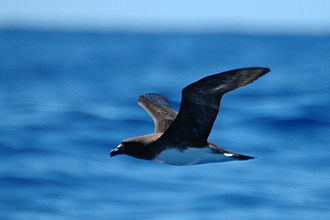
The sooty shearwater (Ardenna grisea) is a medium-large shearwater in the seabird family Procellariidae. In New Zealand, it is also known by its Māori name tītī, and is harvested by Māori people for muttonbird, like its relatives the wedge-tailed shearwater (A. pacificus) and the Australian short-tailed shearwater (A. tenuirostris).
The sooty shearwater was formally described in 1789 by the German naturalist Johann Friedrich Gmelin under the binomial name Procellaria grisea. The shearwater had been briefly described in 1777 by James Cook in the account of his second voyage to the Pacific, but without a valid scientific name; and also in 1785 the English ornithologist John Latham had described a museum specimen, again without giving it a scientific name. The sooty shearwater is now placed in the genus Ardenna, that was described in 1853 by Ludwig Reichenbach. The genus name Ardenna was used to refer to a seabird by Italian naturalist Ulisse Aldrovandi in 1603, and the specific epithet grisea is medieval Latin for "grey". The species is considered to be monotypic; no subspecies are recognised.
It appears to be particularly closely related to the great shearwater (A. gravis... Wikipedia →
Recent sightings of Sooty Shearwater in Manuel Antonio National Park
LIVEiNaturalistClosest Relatives at Manuel Antonio National Park




Global Distribution
Warmer areas are where this animal is recorded most often.
Parks Where Found
Quick answers
What are the chances of seeing a Sooty Shearwater in Manuel Antonio National Park?
Under 5% of wildlife watchers report a Sooty Shearwater sighting in Manuel Antonio National Park, based on 10 verified sightings from GBIF citizen-science data.
When is the best time to see Sooty Shearwater in Manuel Antonio National Park?
July has the highest sighting rate for Sooty Shearwater in Manuel Antonio National Park in our monthly data.