
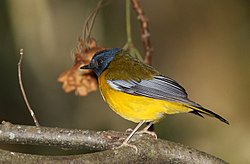


White-starred Robin
Pogonocichla stellata
Silhouette: Martin Bulla, based on François Desbordes' illustration · PhyloPic
- KingdomAnimalia (Animals)
- PhylumChordata (Chordates)
- ClassAves (Birds)
- OrderPasseriformes (Perching Birds)
- FamilyMuscicapidae (Old World Flycatchers, Robins, and Chats)
- GenusPogonocichla
- SpeciesPogonocichla stellata (White-starred Robin)
About the White-starred Robin
The white-starred robin (Pogonocichla stellata) is a species of bird in the Old World flycatcher and chat family Muscicapidae. It is also sometimes more simply called the starred robin. It is monotypic within the genus Pogonocichla. There are around twelve subspecies. The species is found in East and southern Africa. It occurs in forested areas in the Afromontane of sub-Saharan Africa. It is a brightly coloured robin with a bright yellow breast and belly, a slate coloured head with spots on the eyes and throat and blueish wings.
The white-starred robin gives a range of calls that vary geographically. The diet is dominated by insects, although some fruit is taken as well. It is a territorial and seasonal breeder that lays up to three eggs in a domed nest. The generic name Pogoncichla is derived from the Greek pogon for beard, a reference to the white spots on the throat and face, and kikhle for thrush. Similarly the specific name stellata and the species' common name are also derived from the facial spots.
The white-starred robin is related to the chats, subfamily Saxicolinae, a group formerly placed with the thrush family Turdidae, but now placed in the Old World flycatcher... Wikipedia →
Recent sightings of White-starred Robin in Queen Elizabeth National Park
LIVEiNaturalistClosest Relatives at Queen Elizabeth National Park

 White-browed Robin-Chat
Cossypha heuglini

Northern Black-Flycatcher
Melaenornis edolioides

 Swamp Flycatcher
Muscicapa aquatica

Sooty Chat
Myrmecocichla nigra

Snowy-crowned Robin-Chat
Cossypha niveicapilla

 Whinchat
Saxicola rubetra

Brown-backed Scrub Robin
Erythropygia hartlaubi

Red-throated Alethe
Chamaetylas poliophrys

White-browed Scrub Robin
Erythropygia leucophrys

Cassin's Flycatcher
Muscicapa cassini

African Dusky Flycatcher
Muscicapa adusta

Grey Tit-Flycatcher
Myioparus plumbeus
Global Distribution
Warmer areas are where this animal is recorded most often.
Parks Where Found
| # | Park | Country | Daily sighting probability |
|---|---|---|---|
| 1 | Mkomazi National Park | 🇹🇿 Tanzania | |
| 2 | Arusha National Park | 🇹🇿 Tanzania | |
| 3 | Nyungwe National Park | 🇷🇼 Rwanda | |
| 4 | Volcanoes National Park | 🇷🇼 Rwanda | |
| 5 | Tsavo West National Park | 🇰🇪 Kenya | |
| 6 | Bwindi Impenetrable National Park | 🇺🇬 Uganda | |
| 7 | Virunga National Park | 🇨🇩 Democratic Republic of the Congo | |
| 8 | Garden Route National Park | 🇿🇦 South Africa | |
| 9 | Aberdare National Park | 🇰🇪 Kenya | |
| 10 | Tsavo East National Park | 🇰🇪 Kenya | |
| 11 | iSimangaliso Wetland Park | 🇿🇦 South Africa | |
| 12 | Nairobi National Park | 🇰🇪 Kenya | |
| 13 | Ngorongoro Conservation Area | 🇹🇿 Tanzania | |
| 14 | Hluhluwe-Imfolozi Park | 🇿🇦 South Africa | |
| 15 | Gorongosa National Park | 🇲🇿 Mozambique | |
| 16 | Addo Elephant National Park | 🇿🇦 South Africa | |
| 17 | Lake Manyara National Park | 🇹🇿 Tanzania | |
| 18 | Semuliki National Park | 🇺🇬 Uganda | |
| 19 | Kibale National Park | 🇺🇬 Uganda | |
| 20 | Lake Mburo National Park | 🇺🇬 Uganda | |
| 21 | Queen Elizabeth National Park | 🇺🇬 Uganda | |
| 22 | Kruger National Park | 🇿🇦 South Africa |