

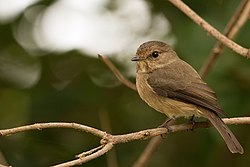



African Dusky Flycatcher
Muscicapa adusta
Silhouette: Ekytza · PhyloPic
- KingdomAnimalia (Animals)
- PhylumChordata (Chordates)
- ClassAves (Birds)
- OrderPasseriformes (Perching Birds)
- FamilyMuscicapidae (Old World Flycatchers, Robins, and Chats)
- GenusMuscicapa (Muscicapa Flycatchers)
- SpeciesMuscicapa adusta (African Dusky Flycatcher)
About the African Dusky Flycatcher
The African dusky flycatcher (Muscicapa adusta), also known as the dusky-brown flycatcher or dusky alseonax, is a small passerine bird of the Old World flycatcher family, Muscicapidae. It is a resident breeder in elevated areas of Sub-Saharan Africa (including the Bié and Western High plateaus). It is very common in its woodland habitat, which includes riverine forests, evergreen forest edges and clearings, especially near water bodies such as lakes, dams and streams, and well-wooded suburban gardens.
The African dusky flycatcher is 13 cm (5.1 in) long and weighs around 11 g (0.39 oz). Its upperparts are plain brown, with the only facial marking being an indistinct narrow eye-ring. The chin is plain pale grey, and the rest of the underparts are grey-brown with indistinct streaks. The short, straight, laterally flattened bill is black, the legs and feet are grey, and the eyes are brown. The sexes are similar, but the juvenile is spotted with buff above, and is whitish spotted with brown below.
This species is similar to the common migrant, the spotted flycatcher, Muscicapa striata, but is smaller and darker, especially on the underparts, than that species. Spotted flycatcher... Wikipedia →
Recent sightings of African Dusky Flycatcher in Queen Elizabeth National Park
LIVEiNaturalistClosest Relatives at Queen Elizabeth National Park

 Swamp Flycatcher
Muscicapa aquatica

Cassin's Flycatcher
Muscicapa cassini

Spotted Flycatcher
Muscicapa striata

Ashy Alseonax
Muscicapa caerulescens

Dusky-blue Flycatcher
Muscicapa comitata

Chapin's Flycatcher
Muscicapa lendu

 White-browed Robin-Chat
Cossypha heuglini

Northern Black-Flycatcher
Melaenornis edolioides

Sooty Chat
Myrmecocichla nigra

Snowy-crowned Robin-Chat
Cossypha niveicapilla

 Whinchat
Saxicola rubetra

Brown-backed Scrub Robin
Erythropygia hartlaubi
Global Distribution
Warmer areas are where this animal is recorded most often.
Parks Where Found
Quick answers
What are the chances of seeing a African Dusky Flycatcher in Queen Elizabeth National Park?
Under 5% of wildlife watchers report a African Dusky Flycatcher sighting in Queen Elizabeth National Park, based on 27 verified sightings from GBIF citizen-science data.
When is the best time to see African Dusky Flycatcher in Queen Elizabeth National Park?
March has the highest sighting rate for African Dusky Flycatcher in Queen Elizabeth National Park in our monthly data.