


White-tailed Mongoose
Ichneumia albicauda
Silhouette: Margot Michaud · PhyloPic
- KingdomAnimalia (Animals)
- PhylumChordata (Chordates)
- ClassMammalia (Mammals)
- OrderCarnivora (Carnivorans)
- FamilyHerpestidae (Mongooses)
- GenusIchneumia (White-tailed Mongooses)
- SpeciesIchneumia albicauda (White-tailed Mongoose)
About the White-tailed Mongoose
The white-tailed mongoose (Ichneumia albicauda) is a species in the mongoose family Herpestidae. It is the only member of the genus Ichneumia. Herpestes albicaudus was the scientific name proposed by Georges Cuvier in 1829 for a mongoose specimen with a white tail from Senegal. The genus name Ichneumia was coined by Isidore Geoffroy Saint-Hilaire in 1837.
The white-tailed mongoose attains a weight range of 1.8 to 5.2 kg (4.0 to 11.5 lb), with an average of approximately 3.38 kg (7.5 lb), has a head-and-body length of 53 to 71 cm (21 to 28 in) and a tail length of 40 to 47 cm (16 to 19 in). On average it appears to be the longest and heaviest extant species of mongoose, although its linear and body mass parameters broadly overlap with other larger mongoose species, in particular, the marsh mongoose seems to most closely rival (and possibly match) in range of body masses reported if not average weight. Its legs are relatively long for a mongoose. The head is long and narrow. Its large, rounded ears are set low on the sides of the head. It has a yellow to tan coloration on its body, with long black guard hairs, giving it an overall grizzled grey appearance... Wikipedia →
Recent sightings of White-tailed Mongoose in Samburu National Reserve
LIVEiNaturalistClosest Relatives at Samburu National Reserve

 Somali Dwarf Mongoose
Helogale hirtula

 Slender Mongoose
Galerella sanguinea

 Common Dwarf Mongoose
Helogale parvula

 Lion
Panthera leo

 Cheetah
Acinonyx jubatus

 Leopard
Panthera pardus

 Northern Small-spotted Genet
Genetta genetta

 Bat-eared Fox
Otocyon megalotis

 Spotted Hyena
Crocuta crocuta
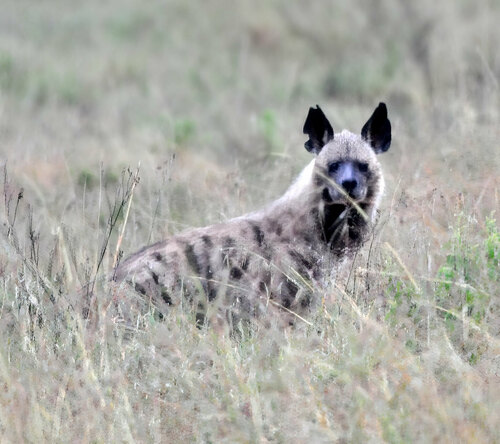
 Hyaena dubbah

 Painted Hunting Dog
Lycaon pictus

Striped Hyena
Hyaena hyaena
Global Distribution
Warmer areas are where this animal is recorded most often.
Parks Where Found
| # | Park | Country | Daily sighting probability |
|---|---|---|---|
| 1 | Liwonde National Park | 🇲🇼 Malawi | |
| 2 | South Luangwa National Park | 🇿🇲 Zambia | |
| 3 | Tsavo West National Park | 🇰🇪 Kenya | |
| 4 | Murchison Falls National Park | 🇺🇬 Uganda | |
| 5 | Tarangire National Park | 🇹🇿 Tanzania | |
| 6 | Tsavo East National Park | 🇰🇪 Kenya | |
| 7 | Masai Mara National Reserve | 🇰🇪 Kenya | |
| 8 | Kruger National Park | 🇿🇦 South Africa | |
| 9 | Serengeti National Park | 🇹🇿 Tanzania | |
| 10 | Kafue National Park | 🇿🇲 Zambia | |
| 11 | Aberdare National Park | 🇰🇪 Kenya | |
| 12 | Kidepo Valley National Park | 🇺🇬 Uganda | |
| 13 | Niokolo-Koba National Park | 🇸🇳 Senegal | |
| 14 | Ruaha National Park | 🇹🇿 Tanzania | |
| 15 | Akagera National Park | 🇷🇼 Rwanda | |
| 16 | Lake Nakuru National Park | 🇰🇪 Kenya | |
| 17 | Lake Mburo National Park | 🇺🇬 Uganda | |
| 18 | Amboseli National Park | 🇰🇪 Kenya | |
| 19 | Mkomazi National Park | 🇹🇿 Tanzania | |
| 20 | Samburu National Reserve | 🇰🇪 Kenya | |
| 21 | Hwange National Park | 🇿🇼 Zimbabwe | |
| 22 | Hluhluwe-Imfolozi Park | 🇿🇦 South Africa | |
| 23 | Pilanesberg National Park | 🇿🇦 South Africa | |
| 24 | Ngorongoro Conservation Area | 🇹🇿 Tanzania |