


Leopard
Panthera pardus
Silhouette: PhyloPic · PhyloPic
- KingdomAnimalia (Animals)
- PhylumChordata (Chordates)
- ClassMammalia (Mammals)
- OrderCarnivora (Carnivorans)
- FamilyFelidae (Felids)
- GenusPanthera (Roaring Cats)
- SpeciesPanthera pardus (Leopard)
About the Leopard
The leopard (Panthera pardus) is one of the five extant cat species in the genus Panthera. It has a pale yellowish to dark golden fur with dark spots grouped in rosettes. Its body is slender and muscular, reaching a length of 92–183 cm (36–72 in) with a 66–102 cm (26–40 in) long tail and a shoulder height of 60–70 cm (24–28 in). Males typically weigh 30.9–72 kg (68–159 lb), and females 20.5–43 kg (45–95 lb).
The leopard was first described in 1758, and several subspecies were proposed in the 19th and 20th centuries. Today, eight subspecies are recognised in its wide range in Africa and Asia. It initially evolved in Africa during the Early Pleistocene, before migrating into Eurasia around the Early–Middle Pleistocene transition. Leopards were formerly present across Europe, but became extinct in the region at around the end of the Late Pleistocene-early Holocene.
The leopard is adapted to a variety of habitats ranging from rainforest to steppe, including arid and montane areas. It is an opportunistic predator, hunting mostly ungulates and primates. It relies on its spotted pattern for camouflage as it stalks and ambushes its prey, which it sometimes drags up a tree. It is a solitary animal outside the mating season and when raising cubs. Females usually give birth to a litter of 2–4 cubs once in 15–24 months. Both male and female leopards typically reach sexual maturity at the age 2–2.5 years.
Listed as Vulnerable on the IUCN Red List, leopard populations are currently threatened by habitat loss and fragmentation, and are declining in large parts of the global range. Leopards have had cultural roles in Ancient Greece, West Africa and modern Western culture. Leopard skins are popular in fashion. Wikipedia →
Recent sightings of Leopard in Samburu National Reserve
LIVEiNaturalistClosest Relatives at Samburu National Reserve

 Lion
Lion
Panthera leo

 Cheetah
Acinonyx jubatus

 Caracal
Caracal caracal

 Somali Dwarf Mongoose
Helogale hirtula

 Northern Small-spotted Genet
Genetta genetta

 Bat-eared Fox
Otocyon megalotis

 Spotted Hyena
Crocuta crocuta
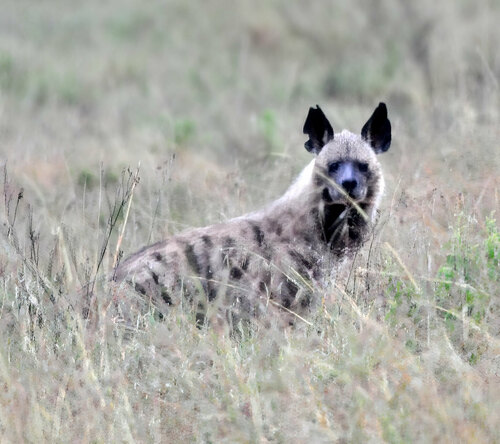
 Hyaena dubbah
Hyaena dubbah

 Slender Mongoose
Galerella sanguinea

 White-tailed Mongoose
Ichneumia albicauda

 Painted Hunting Dog
Lycaon pictus

Striped Hyena
Hyaena hyaena
Global Distribution
Warmer areas are where this animal is recorded most often.
Parks Where Found
Quick answers
What are the chances of seeing a Leopard in Samburu National Reserve?
About 50% of wildlife watchers report a Leopard sighting in Samburu National Reserve, based on 16 verified sightings from GBIF citizen-science data.
When is the best time to see Leopard in Samburu National Reserve?
February has the highest sighting rate for Leopard in Samburu National Reserve in our monthly data.