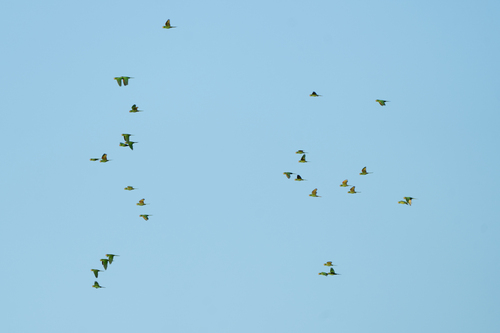

Crimson-fronted Parakeet
Aratinga finschi
Silhouette: Myriam_Ramirez · PhyloPic
- KingdomAnimalia (Animals)
- PhylumChordata (Chordates)
- ClassAves (Birds)
- OrderPsittaciformes (Parrots)
- FamilyPsittacidae (New World and African Parrots)
- GenusAratinga (Aratinga Parakeets)
- SpeciesAratinga finschi (Crimson-fronted Parakeet)
About the Crimson-fronted Parakeet
Finsch's parakeet (Psittacara finschi), also known as the crimson-fronted parakeet and in aviculture as Finsch's conure, is a species of bird in subfamily Arinae of the family Psittacidae, the African and New World parrots. It is found in Costa Rica, Nicaragua, and Panama.
Finsch's parakeet was for a time placed in the genus Aratinga but from about 2013 has been in its present genus Psittacara. It was for a time treated as a subspecies of the white-eyed parakeet (P. leucophthalmus), and they constitute a superspecies. It is monotypic.
Finsch's parakeet is about 28 cm (11 in) long and weighs 135 to 175 g (4.8 to 6.2 oz). The sexes are alike. Adults are mostly green that is yellowish on their underparts. They have a red forehead (the "front" of their alternate English name) and some red flecks elsewhere on their head. The edge of their wing and their outer underwing coverts are also red, often with an orange tinge. Their greater underwing coverts are yellow. The undersides of their flight feathers and tail are olive yellow. Their thighs usually have some red. Their eye is orange surrounded by bare white skin and their bill is horn colored... Wikipedia →
Recent sightings of Crimson-fronted Parakeet in Santa Rosa National Park
LIVEiNaturalistClosest Relatives at Santa Rosa National Park

 Orange-fronted Parakeet
Aratinga canicularis

 Olive-throated Parakeet
Aratinga nana

 Orange-chinned Parakeet
Brotogeris jugularis

 Yellow-naped Parrot
Amazona auropalliata

White-fronted Parrot
Amazona albifrons

Red-lored Parrot
Amazona autumnalis

 Brown-hooded Parrot
Pionopsitta haematotis

Mealy Parrot
Amazona farinosa

White-crowned Parrot
Pionus senilis
Global Distribution
Warmer areas are where this animal is recorded most often.