

Ashy Alseonax
Muscicapa caerulescens
Silhouette: Ekytza · PhyloPic
- KingdomAnimalia (Animals)
- PhylumChordata (Chordates)
- ClassAves (Birds)
- OrderPasseriformes (Perching Birds)
- FamilyMuscicapidae (Old World Flycatchers, Robins, and Chats)
- GenusMuscicapa (Muscicapa Flycatchers)
- SpeciesMuscicapa caerulescens (Ashy Alseonax)
About the Ashy Alseonax
The ashy flycatcher (Fraseria caerulescens) is a species of bird in the Old World flycatcher family Muscicapidae. It is found throughout sub-Saharan Africa, excluding the drier areas of South Africa, Botswana, and Namibia, where it inhabits subtropical or tropical dry forest, subtropical or tropical moist lowland forest, and savanna. It has a disputed generic placement, with different authorities variously putting it in Muscicapa, Fraseria, or other genera. Ashy flycatchers are mostly grey in colour, with pale grey or white underparts, and display no sexual dimorphism.
The species has a small, thin, and pointed beak adapted for eating insects. Its diet is mostly insectivorous, although it also eats berries and small geckoes. The birds are very active, foraging alone, in groups, or in mixed-species flocks. They forage in the upper levels of the canopy, catching prey in flight and from foliage, bark, and leaves. The species breeds in solitary pairs, with each pair maintaining a territory of 1–4 hectares and raising young alone. A variety of vocalisations are used by the species, and there is very little geographical variation in calls.
The ashy flycatcher... Wikipedia →
Recent sightings of Ashy Alseonax in Semuliki National Park
LIVEiNaturalistClosest Relatives at Semuliki National Park

 Spotted Flycatcher
Muscicapa striata

Dusky-blue Flycatcher
Muscicapa comitata

Yellow-footed Flycatcher
Muscicapa sethsmithi

African Dusky Flycatcher
Muscicapa adusta

Swamp Flycatcher
Muscicapa aquatica

Cassin's Flycatcher
Muscicapa cassini

 Brown-chested Alethe
Chamaetylas poliocephala

Grey-throated Flycatcher
Myioparus griseigularis

Blue-shouldered Robin-Chat
Cossypha cyanocampter
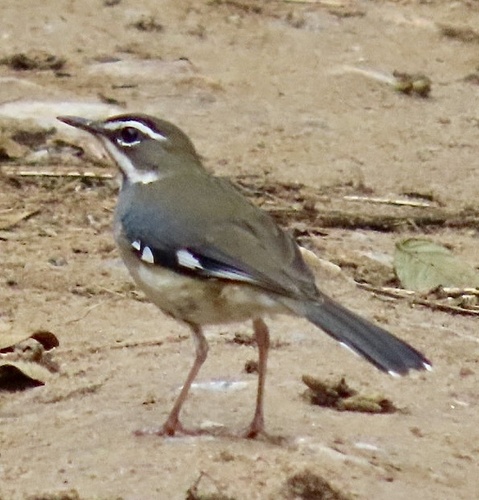
Forest Scrub-Robin
Erythropygia leucosticta

Grey Tit-Flycatcher
Myioparus plumbeus

Brown-backed Scrub Robin
Erythropygia hartlaubi
Global Distribution
Warmer areas are where this animal is recorded most often.
Parks Where Found
Quick answers
What are the chances of seeing a Ashy Alseonax in Semuliki National Park?
About 10% of wildlife watchers report a Ashy Alseonax sighting in Semuliki National Park, based on 41 verified sightings from GBIF citizen-science data.
When is the best time to see Ashy Alseonax in Semuliki National Park?
August has the highest sighting rate for Ashy Alseonax in Semuliki National Park in our monthly data.