


Bar-winged Flycatcher-shrike
Hemipus picatus
- KingdomAnimalia (Animals)
- PhylumChordata (Chordates)
- ClassAves (Birds)
- OrderPasseriformes (Perching Birds)
- FamilyTephrodornithidae
- GenusHemipus (Flycatcher-shrikes)
- SpeciesHemipus picatus (Bar-winged Flycatcher-shrike)
About the Bar-winged Flycatcher-shrike
The bar-winged flycatcher-shrike (Hemipus picatus) is a small passerine bird usually placed in the Vangidae. It is found in the forests of tropical southern Asia from the Himalayas and hills of southern India to Indonesia. Mainly insectivorous it is found hunting in the mid-canopy of forests, often joining mixed-species foraging flocks. They perch upright and have a distinctive pattern of black and white, males being more shiny black than the females. In some populations the colour of the back is brownish while others have a dark wash on the underside.
The bar-winged flycatcher-shrike is black capped with black wings that contrast with the white of the body. A white slash across the wing and a white rump stand out in contrast. They sit upright on branches, flying around to glean insects. The nostril is hidden by hairs and the upper mandible of the beak has a curved tip. Males are velvety black while females tend to be greyish brown but the pattern varies across the geographic populations. Both males and females of the Himalayan H. p. capitalis have a brown back but the males have a black head. The Sri Lankan population leggei lacks sexual dimorphism in plumage. H... Wikipedia →
Closest Relatives at Tanjung Puting National Park

Black-winged Flycatcher-shrike
Hemipus hirundinaceus

Rufous-winged Philentoma
Philentoma pyrhoptera

Malaysian Pied-Fantail
Rhipidura javanica

Black-and-red Broadbill
Cymbirhynchus macrorhynchos

Olive-winged Bulbul
Pycnonotus plumosus
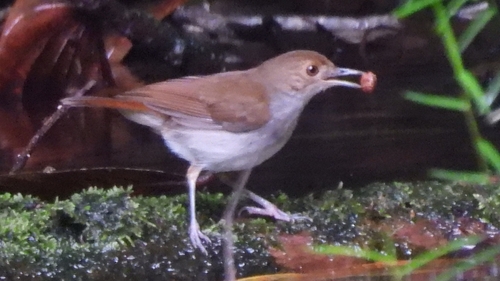
White-chested Babbler
Trichastoma rostratum

Little Spiderhunter
Arachnothera longirostra

Slender-billed Crow
Corvus enca

Van Hasselt's Sunbird
Leptocoma brasiliana

Malaysian Blue-Flycatcher
Cyornis turcosus

Greater Racket-tailed Drongo
Dicrurus paradiseus

Green Iora
Aegithina viridissima
Global Distribution
Where this species is recorded worldwide. Restricted to human observations from 2019 onwards — the same kind of record and the same period the probabilities on this page are built from, so collar-tracking studies, camera-trap arrays and museum specimens are excluded. Around Santa Rosa that removes 5,924 GPS fixes from a handful of tagged jaguars.
where this species is recorded (GBIF density — it tracks where observers go, not how likely a sighting is) · parks where it occurs — tap a pin for the sighting probability there