

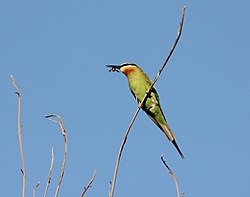



Madagascar Bee-eater
Merops superciliosus
Silhouette: Sheatherius · PhyloPic
- KingdomAnimalia (Animals)
- PhylumChordata (Chordates)
- ClassAves (Birds)
- OrderCoraciiformes (Rollers, Kingfishers, and Allies)
- FamilyMeropidae (Bee-eaters)
- GenusMerops (Typical Bee-eaters)
- SpeciesMerops superciliosus (Madagascar Bee-eater)
About the Madagascar Bee-eater
The olive bee-eater or Madagascar bee-eater (Merops superciliosus) is a bee-eater species in the genus Merops. It is native to the southern half of Africa where it is present in Angola; Botswana; Burundi; Comoros; Democratic Republic of the Congo; Djibouti; Eritrea; Ethiopia; Kenya; Madagascar; Malawi; Mayotte; Mozambique; Namibia; Rwanda; Somalia; South Sudan; Sudan; Tanzania; Uganda; Zambia; Zimbabwe. It is a common species with a wide range so the International Union for Conservation of Nature has rated their conservation status as "least concern".
In 1760 the French zoologist Mathurin Jacques Brisson included a description of the olive bee-eater in his Ornithologie based on a specimen collected on the island of Madagascar. He used the French name Le guespier de Madagascar and the Latin Apiaster Madagascariensis. Although Brisson coined Latin names, these do not conform to the binomial system and are not recognised by the International Commission on Zoological Nomenclature. When in 1766 the Swedish naturalist Carl Linnaeus updated his Systema Naturae for the twelfth edition, he added 240 species that had been previously described by Brisson. One of these was the olive... Wikipedia →
Recent sightings of Madagascar Bee-eater in Tarangire National Park
LIVEiNaturalistClosest Relatives at Tarangire National Park

 Little Bee-eater
Merops pusillus

Blue-cheeked Bee-eater
Merops persicus

European Bee-eater
Merops apiaster

Cinnamon-chested Bee-eater
Merops oreobates

White-fronted Bee-eater
Merops bullockoides

Northern Carmine Bee-eater
Merops nubicus

Whitethroated Bee-eater
Merops albicollis

 Lilac-breasted Roller
Coracias caudatus

 Gray-headed Kingfisher
Halcyon leucocephala

Woodland Kingfisher
Halcyon senegalensis

 European Roller
Coracias garrulus

Striped Kingfisher
Halcyon chelicuti
Global Distribution
Warmer areas are where this animal is recorded most often.
Parks Where Found
Quick answers
What are the chances of seeing a Madagascar Bee-eater in Tarangire National Park?
Under 5% of wildlife watchers report a Madagascar Bee-eater sighting in Tarangire National Park, based on 37 verified sightings from GBIF citizen-science data.
When is the best time to see Madagascar Bee-eater in Tarangire National Park?
March has the highest sighting rate for Madagascar Bee-eater in Tarangire National Park in our monthly data.