


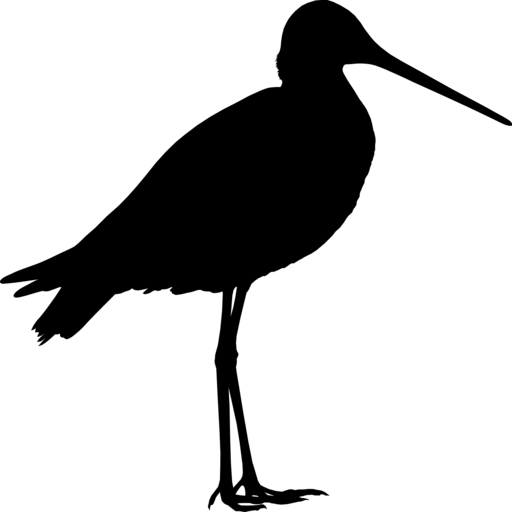
Black-tailed Godwit
Limosa limosa
Silhouette: Alexandre Vong · PhyloPic
- KingdomAnimalia (Animals)
- PhylumChordata (Chordates)
- ClassAves (Birds)
- OrderCharadriiformes (Shorebirds and Allies)
- FamilyScolopacidae (Sandpipers and Allies)
- GenusLimosa (Godwits)
- SpeciesLimosa limosa (Black-tailed Godwit)
About the Black-tailed Godwit
The black-tailed godwit (Limosa limosa) is a large, long-legged, long-billed shorebird first described by Carl Linnaeus in 1758. It is a member of the godwit genus, Limosa. There are four subspecies, all with orange head, neck and chest in breeding plumage and dull grey-brown winter coloration, and distinctive black and white wingbar at all times.
Its breeding range stretches from Iceland through Europe and areas of central Asia. Black-tailed godwits spend (the northern hemisphere) winter in areas as diverse as the Indian subcontinent, Australia, New Zealand, western Europe and west Africa. The species breeds in fens, lake edges, damp meadows, moorlands and bogs and uses estuaries, swamps and floods in (the northern hemisphere) winter; it is more likely to be found inland and on freshwater than the similar bar-tailed godwit. The world population is estimated to be 634,000 to 805,000 birds and is classified as Near Threatened.
The black-tailed godwit was formally described by the Swedish naturalist Carl Linnaeus in 1758 in the tenth edition of his Systema Naturae under the binomial name Scolopax limosa. It is now placed with three other godwits in the genus Limosa that... Wikipedia →
Recent sightings of Black-tailed Godwit in Bandhavgarh National Park
LIVEiNaturalistClosest Relatives at Bandhavgarh National Park

 Green Sandpiper
Tringa ochropus

 Common Sandpiper
Actitis hypoleucos

Wood Sandpiper
Tringa glareola

Common Greenshank
Tringa nebularia

Marsh Sandpiper
Tringa stagnatilis

 Common Snipe
Gallinago gallinago

 Temminck's Stint
Calidris temminckii

 Eurasian Curlew
Numenius arquata

 Red-wattled Lapwing
Vanellus indicus

 Indian Thick-knee
Burhinus indicus

Yellow-wattled Lapwing
Vanellus malabaricus

 Bronze-winged Jacana
Metopidius indicus
Global Distribution
Warmer areas are where this animal is recorded most often.