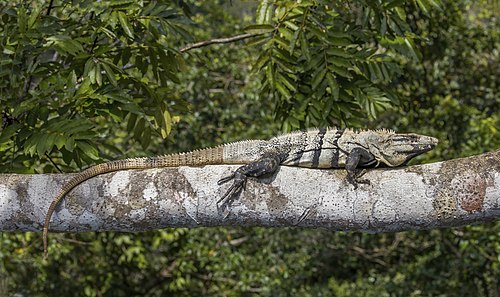



Black Spiny-tailed Iguana
Ctenosaura similis
Silhouette: SeismicShrimp · PhyloPic
- KingdomAnimalia (Animals)
- PhylumChordata (Chordates)
- ClassSquamata
- FamilyIguanidae (Iguanas and Chuckwallas)
- GenusCtenosaura (Spiny-tailed Iguanas)
- SpeciesCtenosaura similis (Black Spiny-tailed Iguana)
About the Black Spiny-tailed Iguana
Ctenosaura similis, commonly known as the black iguana or black spiny-tailed iguana, is an iguanid lizard native to Mexico and Central America. It has been reported in some Colombian islands in the Caribbean Sea and Pacific Ocean, and has been introduced to the United States in the state of Florida. The largest species in the genus Ctenosaura, it is commonly found in areas such as grasslands and forests.
C. similis was first described by British zoologist John Edward Gray in 1831. The generic name—Ctenosaura—is derived from two Greek words: ctenos (Κτενός), meaning "comb" (referring to the comblike spines on the lizard's back and tail), and saura (σαύρα), meaning "lizard". The specific name—similis—is a Latin word meaning "similar to", a common description found in Linnaean taxonomy when referring to a new taxon.
The black spiny-tailed iguana is native to southern Mexico and Central America, ranging from the Isthmus of Tehuantepec southward to Panama, occurring at sea level to ca. 1,320 meters elevation, but it is absent from interior highlands. Its distribution is irregular and discontinuous on the Atlantic versant where it ranges through portions... Wikipedia →
Recent sightings of Black Spiny-tailed Iguana in Cockscomb Basin Wildlife Sanctuary
LIVEiNaturalistClosest Relatives at Cockscomb Basin Wildlife Sanctuary


Global Distribution
Warmer areas are where this animal is recorded most often.