




Red-throated Pipit
Anthus cervinus
Silhouette: Susan Murphy (original photograph), T. Michael Keesey (vectorization) · PhyloPic
- KingdomAnimalia (Animals)
- PhylumChordata (Chordates)
- ClassAves (Birds)
- OrderPasseriformes (Perching Birds)
- FamilyMotacillidae (Wagtails and Pipits)
- GenusAnthus (Pipits)
- SpeciesAnthus cervinus (Red-throated Pipit)
About the Red-throated Pipit
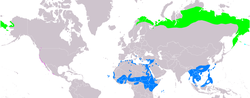
The red-throated pipit (Anthus cervinus) is a small passerine bird, which breeds in the far north of Europe and the Palearctic, with a foothold in northern Alaska. It is a long-distance migrant, wintering to Africa and South-East Asia and western Alaska in North America. It is vagrant to Western Europe.
The scientific name is from Latin. The generic name Anthus is the name for a small bird of grasslands, and the specific name cervinus means "stag-coloured", from cervus, "stag". This is a small pipit, with an adult easily identified in the breeding season by its brick-red face and throat. In other plumages, this is an undistinguished-looking species, heavily streaked brown above, with whitish mantle stripes, and with black markings on a white background below. It is very similar in appearance to the meadow pipit, and in the autumn, it much resembles the tree pipit, but has an altogether more striped appearance because of the larger numbers of streaks on the cap, back, flank, rump, and chest. The flight of the red-throated pipit is strong and direct, and it gives a characteristic psii call as it flies.
The red-throated pipit is native... Wikipedia →
Recent sightings of Red-throated Pipit in Great Bear Rainforest
LIVEiNaturalistClosest Relatives at Great Bear Rainforest

 American Pipit
Anthus rubescens

Olive-backed Pipit
Anthus hodgsoni

 White Wagtail
Motacilla alba

 American Crow
Corvus brachyrhynchos

Common Raven
Corvus corax

 American Robin
Turdus migratorius

 Song Sparrow
Melospiza melodia

 Dark-eyed Junco
Junco hyemalis

 Chestnut-backed Chickadee
Poecile rufescens

 Golden-crowned Kinglet
Regulus satrapa

 Steller's Jay
Cyanocitta stelleri

 Pacific Wren
Troglodytes pacificus
Global Distribution
Warmer areas are where this animal is recorded most often.