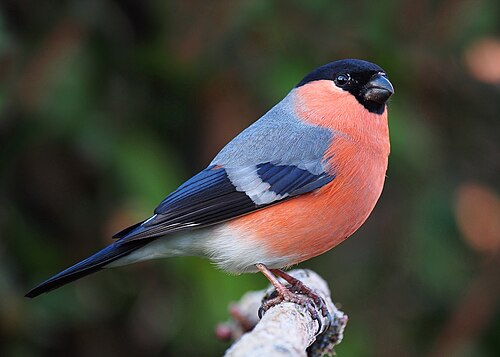


Eurasian Bullfinch
Pyrrhula pyrrhula
- KingdomAnimalia (Animals)
- PhylumChordata (Chordates)
- ClassAves (Birds)
- OrderPasseriformes (Perching Birds)
- FamilyFringillidae (Finches, Euphonias, and Allies)
- GenusPyrrhula (Bullfinches)
- SpeciesPyrrhula pyrrhula (Eurasian Bullfinch)
About the Eurasian Bullfinch
The Eurasian bullfinch or common bullfinch (Pyrrhula pyrrhula) is a small passerine bird in the finch family, Fringillidae. In Anglophone Europe it is known simply as the bullfinch (English regional, Shropshire: plum bird), as it is the original bird to bear the name bullfinch.
The Eurasian bullfinch was formally described in 1758 by Linnaeus in the 10th edition of his Systema Naturae under the binomial name Loxia pyrrhula. It is now placed in the genus Pyrrhula that was introduced in 1760 by the French zoologist Mathurin Jacques Brisson. The Latin word pyrrhula comes from the Greek πυρρός (a flame-coloured bird, from πυρρός 'flame-coloured', from πυρ 'fire': Pyrrha), a 'worm eating bird' that is mentioned by Aristotle. The Latin name pyrrhula for the Eurasian bullfinch had been used in 1555 by the Swiss naturalist Conrad Gessner in his Historiae animalium.
Ten subspecies are recognised: P. p. pileata MacGillivray, W, 1837 – British Isles P. p. pyrrhula (Linnaeus, 1758) – north, south central and east Europe across to central Siberia P. p. europaea Vieillot, 1816 – Western Europe
P. p. iberiae Voous, 1951 – southwest France, northern... Wikipedia →
Closest Relatives at Hohe Tauern National Park

Chaffinch
Fringilla coelebs

Eurasian Goldfinch
Carduelis carduelis

Linnet
Linaria cannabina

Common Redpoll
Acanthis flammea

European Serin
Serinus serinus

Red Crossbill
Loxia curvirostra

Eurasian Siskin
Spinus spinus

Brambling
Fringilla montifringilla

European Greenfinch
Chloris chloris

Hawfinch
Coccothraustes coccothraustes

Citril Finch
Carduelis citrinella

Black Redstart
Phoenicurus ochruros
Global Distribution
Where this species is recorded worldwide. Restricted to human observations from 2019 onwards — the same kind of record and the same period the probabilities on this page are built from, so collar-tracking studies, camera-trap arrays and museum specimens are excluded. Around Santa Rosa that removes 5,924 GPS fixes from a handful of tagged jaguars.
where this species is recorded (GBIF density — it tracks where observers go, not how likely a sighting is) · parks where it occurs — tap a pin for the sighting probability there
Parks Where Found
Quick answers
What are the chances of seeing a Eurasian Bullfinch in Hohe Tauern National Park?
About 20% of wildlife watchers report a Eurasian Bullfinch sighting in Hohe Tauern National Park, based on 30 verified sightings from GBIF citizen-science data.
When is the best time to see Eurasian Bullfinch in Hohe Tauern National Park?
May has the highest sighting rate for Eurasian Bullfinch in Hohe Tauern National Park in our monthly data.