


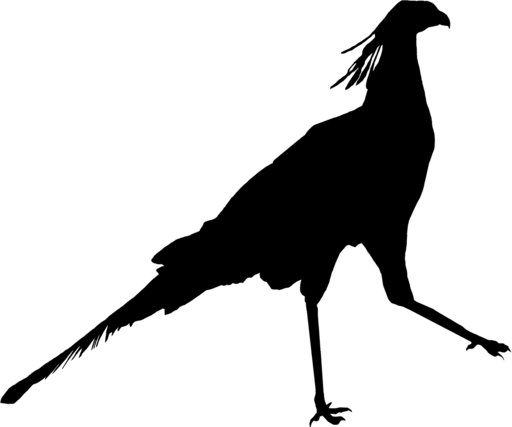
Secretary Bird
Sagittarius serpentarius
Silhouette: Danielle Alba · PhyloPic
- KingdomAnimalia (Animals)
- PhylumChordata (Chordates)
- ClassAves (Birds)
- OrderAccipitriformes (Hawks, Eagles, Kites, and Allies)
- FamilySagittariidae (Secretarybirds)
- GenusSagittarius (Secretarybirds)
- SpeciesSagittarius serpentarius (Secretary Bird)
About the Secretary Bird
The secretarybird or secretary bird (Sagittarius serpentarius) is a large bird of prey that is endemic to Africa. It is mostly terrestrial, spending most of its time on the ground, and is usually found in the open grasslands and savanna of the sub-Saharan region. John Frederick Miller described the species in 1779. A member of the order Accipitriformes, which also includes many other diurnal birds of prey such as eagles, hawks, kites, vultures, and harriers, it is placed in its own family, the Sagittariidae.
The secretarybird is instantly recognizable as a very large bird with an eagle-like body on crane-like legs that give the bird a height of as much as 1.3 m (4 ft 3 in). The sexes are similar in appearance. Adults have a featherless, red-orange face and predominantly grey plumage, with a flattened dark crest and black flight feathers and thighs.
Breeding can take place at any time of year, but tends to be late in the dry season. The nest is built at the top of a thorny tree, and a clutch of one to three eggs is laid. In years with plentiful food, all three young can survive to fledging. The secretarybird hunts and catches prey on the ground, often stomping on victims to kill them. Insects and small vertebrates make up its diet.
Although the secretarybird resides over a large range, the results of localized surveys suggest that the total population is experiencing a rapid decline, probably as a result of habitat destruction. The species is therefore classed as endangered by the International Union for Conservation of Nature. The secretarybird appears on the coats of arms of South Africa and Sudan. Wikipedia →
Recent sightings of Secretary Bird in iSimangaliso Wetland Park
LIVEiNaturalistClosest Relatives at iSimangaliso Wetland Park

 Black Kite
Milvus migrans

 African Fish-Eagle
Haliaeetus vocifer

 Brown Snake Eagle
Circaetus cinereus

Black-breasted Snake Eagle
Circaetus pectoralis

African Harrier-Hawk
Polyboroides typus

 Common Buzzard
Buteo buteo

 African Marsh-Harrier
Circus ranivorus

 Osprey
Pandion haliaetus

Fasciated Snake Eagle
Circaetus fasciolatus

African Cuckoo-Hawk
Aviceda cuculoides

 Ayres's Hawk-Eagle
Hieraaetus ayresii

Long-crested Eagle
Lophaetus occipitalis
Global Distribution
Warmer areas are where this animal is recorded most often.
Parks Where Found
Quick answers
What are the chances of seeing a Secretary Bird in iSimangaliso Wetland Park?
Under 5% of wildlife watchers report a Secretary Bird sighting in iSimangaliso Wetland Park, based on 107 verified sightings from GBIF citizen-science data.
When is the best time to see Secretary Bird in iSimangaliso Wetland Park?
July has the highest sighting rate for Secretary Bird in iSimangaliso Wetland Park in our monthly data.