




Red-throated Pipit
Anthus cervinus
Silhouette: Susan Murphy (original photograph), T. Michael Keesey (vectorization) · PhyloPic
- KingdomAnimalia (Animals)
- PhylumChordata (Chordates)
- ClassAves (Birds)
- OrderPasseriformes (Perching Birds)
- FamilyMotacillidae (Wagtails and Pipits)
- GenusAnthus (Pipits)
- SpeciesAnthus cervinus (Red-throated Pipit)
About the Red-throated Pipit
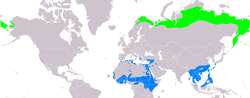
The red-throated pipit (Anthus cervinus) is a small passerine bird, which breeds in the far north of Europe and the Palearctic, with a foothold in northern Alaska. It is a long-distance migrant, wintering to Africa and South-East Asia and western Alaska in North America. It is vagrant to Western Europe.
The scientific name is from Latin. The generic name Anthus is the name for a small bird of grasslands, and the specific name cervinus means "stag-coloured", from cervus, "stag". This is a small pipit, with an adult easily identified in the breeding season by its brick-red face and throat. In other plumages, this is an undistinguished-looking species, heavily streaked brown above, with whitish mantle stripes, and with black markings on a white background below. It is very similar in appearance to the meadow pipit, and in the autumn, it much resembles the tree pipit, but has an altogether more striped appearance because of the larger numbers of streaks on the cap, back, flank, rump, and chest. The flight of the red-throated pipit is strong and direct, and it gives a characteristic psii call as it flies.
The red-throated pipit is native... Wikipedia →
Recent sightings of Red-throated Pipit in Kiskunság National Park
LIVEiNaturalistClosest Relatives at Kiskunság National Park

 Meadow Pipit
Anthus pratensis

 Tree Pipit
Anthus trivialis

Water Pipit
Anthus spinoletta

Tawny Pipit
Anthus campestris

 White Wagtail
Motacilla alba

Western Yellow Wagtail
Motacilla flava

Grey Wagtail
Motacilla cinerea

Citrine Wagtail
Motacilla citreola

 Hooded Crow
Corvus cornix

 European Starling
Sturnus vulgaris

 Rook
Rook
Corvus frugilegus

 Great Tit
Parus major
Global Distribution
Warmer areas are where this animal is recorded most often.
Parks Where Found
Quick answers
What are the chances of seeing a Red-throated Pipit in Kiskunság National Park?
About 10% of wildlife watchers report a Red-throated Pipit sighting in Kiskunság National Park, based on 87 verified sightings from GBIF citizen-science data.
When is the best time to see Red-throated Pipit in Kiskunság National Park?
October has the highest sighting rate for Red-throated Pipit in Kiskunság National Park in our monthly data.