


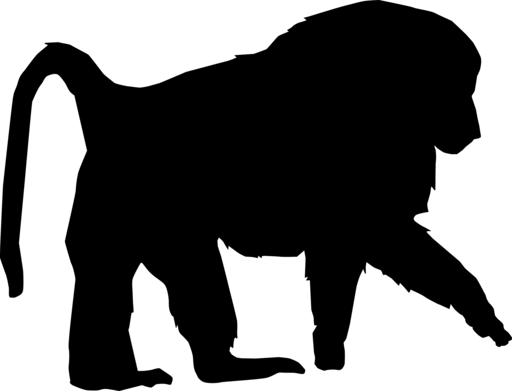
Olive Baboon
Papio anubis
Silhouette: Margot Michaud · PhyloPic
- KingdomAnimalia (Animals)
- PhylumChordata (Chordates)
- ClassMammalia (Mammals)
- OrderPrimates
- FamilyCercopithecidae (Old World Monkeys)
- GenusPapio (Baboons)
- SpeciesPapio anubis (Olive Baboon)
About the Olive Baboon
The olive baboon (Papio anubis), also called the Anubis baboon, is a member of the family Cercopithecidae Old World monkeys. The species is the most wide-ranging of all baboons, being native to 25 countries throughout Africa, extending from Mali eastward to Ethiopia and Tanzania. Isolated populations are also present in some mountainous regions of the Sahara. It inhabits savannahs, steppes, and forests. The common name is derived from its coat colour, which is a shade of green-grey at a distance. A variety of communications, vocal and non-vocal, facilitate a complex social structure.
The olive baboon is named for its coat, which, at a distance, is a shade of green-grey. At closer range, its coat is multicoloured, due to rings of yellow-brown and black on the hairs. The hair on the baboon's face is coarser and ranges from dark grey to black. This coloration is shared by both sexes, although males have a mane of longer hair that tapers down to ordinary length along the back.
Besides the mane, the male olive baboon differs from the female in terms of weight, body and canine tooth size; males are, on average, 70 cm (28 in) tall while standing and females measure 60... Wikipedia →
Recent sightings of Olive Baboon in Lake Manyara National Park
LIVEiNaturalistClosest Relatives at Lake Manyara National Park


Global Distribution
Warmer areas are where this animal is recorded most often.
Parks Where Found
Quick answers
What are the chances of seeing a Olive Baboon in Lake Manyara National Park?
About 80% of wildlife watchers report a Olive Baboon sighting in Lake Manyara National Park, based on 241 verified sightings from GBIF citizen-science data.
When is the best time to see Olive Baboon in Lake Manyara National Park?
May has the highest sighting rate for Olive Baboon in Lake Manyara National Park in our monthly data.