



Rufous Motmot
Baryphthengus martii
Silhouette: Sofía Terán Sánchez · PhyloPic
- KingdomAnimalia (Animals)
- PhylumChordata (Chordates)
- ClassAves (Birds)
- OrderCoraciiformes (Rollers, Kingfishers, and Allies)
- FamilyMomotidae (Motmots)
- GenusBaryphthengus (Large Motmots)
- SpeciesBaryphthengus martii (Rufous Motmot)
About the Rufous Motmot
The rufous motmot (Baryphthengus martii) is a near-passerine bird in the family Momotidae. It is found from northeastern Honduras south to western Ecuador, northern Bolivia, and western Brazil. The rufous motmot and rufous-capped motmot (Baryphtengus ruficapillus) are the only two species in their genus, and have sometimes been treated as conspecific and apparently form a superspecies. The rufous motmot has two recognized subspecies, the nominate Baryphthengus martii martii and B. m. semirufus. In the early 20th century, B. m. martii was classified in its own genus, Urospatha. Later, the Nicaraguan and Costa Rican populations were considered to be a third subspecies, B. m. costaricensis, but it was decided they were part of B. m. semirufus. The binomial commemorates the German botanist and explorer Carl Friedrich Philipp von Martius.
The rufous motmot is the second-largest member of its family. The male of the nominate subspecies is 42 to 47 cm (17 to 19 in) long and weighs 146 to 160 g (5.1 to 5.6 oz). The female weighs 153 to 173 g (5.4 to 6.1 oz). Male and female B. m. semirufus weigh 185 to 193 g (6.5 to 6.8 oz) and 170 to 208 g... Wikipedia →
Recent sightings of Rufous Motmot in Manu National Park
LIVEiNaturalistClosest Relatives at Manu National Park

 Amazonian Motmot
Momotus momota

Andean Motmot
Momotus aequatorialis

Broad-billed Motmot
Electron platyrhynchum

 Amazon Kingfisher
Chloroceryle amazona

 Ringed Kingfisher
Megaceryle torquata

Green Kingfisher
Chloroceryle americana
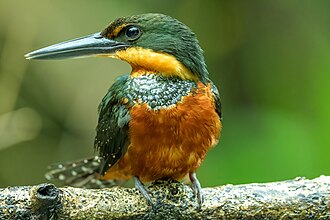
Green-and-rufous Kingfisher
Chloroceryle inda

American Pygmy Kingfisher
Chloroceryle aenea
Global Distribution
Warmer areas are where this animal is recorded most often.
Parks Where Found
Quick answers
What are the chances of seeing a Rufous Motmot in Manu National Park?
About 10% of wildlife watchers report a Rufous Motmot sighting in Manu National Park, based on 403 verified sightings from GBIF citizen-science data.
When is the best time to see Rufous Motmot in Manu National Park?
September has the highest sighting rate for Rufous Motmot in Manu National Park in our monthly data.