


Dunnock
Prunella modularis
Silhouette: Matt Wilkins · PhyloPic
- KingdomAnimalia (Animals)
- PhylumChordata (Chordates)
- ClassAves (Birds)
- OrderPasseriformes (Perching Birds)
- FamilyPrunellidae (Accentors)
- GenusPrunella (selfheals)
- SpeciesPrunella modularis (Dunnock)
About the Dunnock
The dunnock (Prunella modularis) is a small passerine, or perching bird, found throughout temperate Europe and into Asian Russia. Dunnocks have also been introduced and become common in New Zealand. It is the most widespread member of the accentor family; most other accentors are limited to mountain habitats. Other, largely archaic, English names for the dunnock include hedge accentor, hedge sparrow, hedge warbler, and titling.
The dunnock was described by the Swedish naturalist Carl Linnaeus in 1758 in the tenth edition of his Systema Naturae. He coined the binomial name of Motacilla modularis. The specific epithet is from the Latin modularis "modulating" or "singing". This species is now placed in the genus Prunella that was introduced by the French ornithologist Louis Pierre Vieillot in 1816.
The name "dunnock" comes from the English dun (dingy brown, dark-coloured) and the diminutive form of bird ock (thus, the original "little brown bird"), while "accentor" is from post-classical Latin and means a person who sings with another. The genus name Prunella is from the German Braunelle, "dunnock", a diminutive of braun, "brown".
Seven subspecies are accepted by the IOC... Wikipedia →
Recent sightings of Dunnock in Mercantour National Park
LIVEiNaturalistClosest Relatives at Mercantour National Park
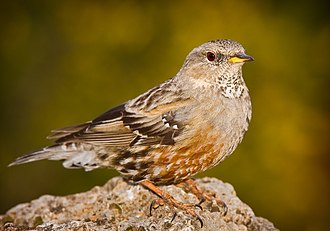
 Alpine Accentor
Prunella collaris

 Chaffinch
Fringilla coelebs

 Black Redstart
Phoenicurus ochruros

 Carrion Crow
Corvus corone

 Great Tit
Parus major

 Eurasian Blackbird
Turdus merula

 European Robin
Erithacus rubecula

 Eurasian Jay
Garrulus glandarius

 Common Chiffchaff
Phylloscopus collybita

 Eurasian Goldfinch
Carduelis carduelis

 Coal Tit
Periparus ater

 Blackcap
Sylvia atricapilla
Global Distribution
Warmer areas are where this animal is recorded most often.
Parks Where Found
Quick answers
What are the chances of seeing a Dunnock in Mercantour National Park?
About 10% of wildlife watchers report a Dunnock sighting in Mercantour National Park, based on 54 verified sightings from GBIF citizen-science data.
When is the best time to see Dunnock in Mercantour National Park?
June has the highest sighting rate for Dunnock in Mercantour National Park in our monthly data.