


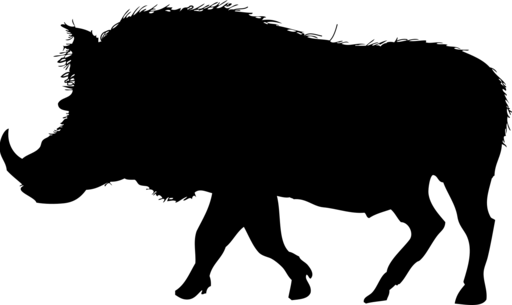
Common Warthog
Phacochoerus africanus
Silhouette: Steven Traver · PhyloPic
- KingdomAnimalia (Animals)
- PhylumChordata (Chordates)
- ClassMammalia (Mammals)
- OrderArtiodactyla (Even-toed Ungulates and Cetaceans)
- FamilySuidae (Suids)
- GenusPhacochoerus (Warthogs)
- SpeciesPhacochoerus africanus (Common Warthog)
About the Common Warthog
The common warthog (Phacochoerus africanus) is a wild member of the pig family (Suidae) found in grassland, savanna, and woodland in sub-Saharan Africa. In the past, it was commonly treated as a subspecies of P. aethiopicus, but today that scientific name is restricted to the desert warthog of northern Kenya, Somalia, and eastern Ethiopia.
The common warthog is a medium-sized species, with a head-and-body length ranging from 0.9 to 1.5 m (2 ft 11 in to 4 ft 11 in), and shoulder height from 63.5 to 85 cm (25.0 to 33.5 in). Females, at 45 to 75 kg (99 to 165 lb), are smaller and lighter than males, at 60 to 150 kg (130 to 330 lb). A warthog is identifiable by the two pairs of tusks protruding from the mouth and curving upwards. The lower pair, which is far shorter than the upper pair, becomes razor-sharp by rubbing against the upper pair every time the mouth is opened and closed. The upper canine teeth can grow to 25.5 cm (10.0 in) long and have a wide elliptical cross section, being about 4.5 cm (1.8 in) deep and 2.5 cm (0.98 in) wide. A tusk will curve 90° or more from the root, and will not lie flat on a table, as it curves somewhat backwards as... Wikipedia →
Recent sightings of Common Warthog in Mkomazi National Park
LIVEiNaturalistClosest Relatives at Mkomazi National Park

 East African Giraffe
Giraffa tippelskirchi

 Hartebeest
Alcelaphus buselaphus

 Common Eland
Taurotragus oryx

 East African Oryx
Oryx beisa

 African Buffalo
Syncerus caffer

 Lesser Kudu
Tragelaphus imberbis

 Gerenuk
Litocranius walleri

 Impala
Aepyceros melampus

 Grant's Gazelle
Nanger granti

Steenbok
Raphicerus campestris

 Waterbuck
Kobus ellipsiprymnus

 Bohor Reedbuck
Redunca redunca
Global Distribution
Warmer areas are where this animal is recorded most often.