
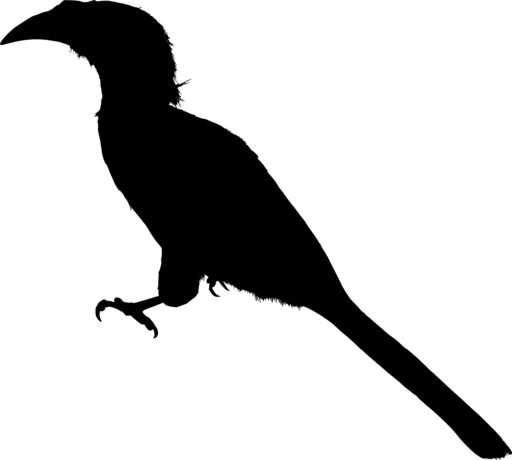
Crowned Hornbill
Lophoceros alboterminatus
Silhouette: Charles J. Sharp and T. Michael Keesey · PhyloPic
- KingdomAnimalia (Animals)
- PhylumChordata (Chordates)
- ClassAves (Birds)
- OrderBucerotiformes (Hornbills and Hoopoes)
- FamilyBucerotidae (Hornbills)
- GenusLophoceros (Whistling Hornbills)
- SpeciesLophoceros alboterminatus (Crowned Hornbill)
About the Crowned Hornbill
The crowned hornbill (Lophoceros alboterminatus) is an African hornbill. It is a medium-sized bird, 50–54 centimetres (20–21 in) in length, and is characterized by its white belly and black back and wings. The tips of the long tail feathers are white. The eyes are yellow; the beak is red and presents a stocky casque on the upper mandible. In females, the casque is smaller. The crowned hornbill can be distinguished from the similar Bradfield's hornbill by its shorter beak.
The crowned hornbill is a common resident of the coastal and riverine forests of southern (only the eastern coast) to northeastern Africa. It forages mainly in trees, where it feeds on insects (often caught in flight), small rodents, small reptiles, eggs, seeds and fruits. This hornbill species can be seen in flocks, usually in the dry season. Four to five white eggs are incubated for 25 to 30 days; the juveniles remain with both parents for about 8 weeks.
Gordon Lindsay Maclean, Robert's Birds of South Africa, 6th Edition ISBN 0-620-17583-4 Wikipedia →
Recent sightings of Crowned Hornbill in Ngorongoro Conservation Area
LIVEiNaturalistClosest Relatives at Ngorongoro Conservation Area

 African Grey Hornbill
Lophoceros nasutus

Silvery-cheeked Hornbill
Bycanistes brevis

 Von der Decken's Hornbill
Tockus deckeni

Northern Red-billed Hornbill
Tockus erythrorhynchus

Tanzanian Red-billed Hornbill
Tockus ruahae

Trumpeter Hornbill
Bycanistes bucinator

Eastern Yellow-billed Hornbill
Tockus flavirostris

 Common Hoopoe
Upupa epops
African Hoopoe
Upupa africana

 Southern Ground-Hornbill
Bucorvus leadbeateri

 Abyssinian Scimitarbill
Rhinopomastus minor

 Green Wood Hoopoe
Phoeniculus purpureus
Global Distribution
Warmer areas are where this animal is recorded most often.
Parks Where Found
Quick answers
What are the chances of seeing a Crowned Hornbill in Ngorongoro Conservation Area?
About 10% of wildlife watchers report a Crowned Hornbill sighting in Ngorongoro Conservation Area, based on 242 verified sightings from GBIF citizen-science data.
When is the best time to see Crowned Hornbill in Ngorongoro Conservation Area?
August has the highest sighting rate for Crowned Hornbill in Ngorongoro Conservation Area in our monthly data.