


Wandering Tattler
Tringa incana
- KingdomAnimalia (Animals)
- PhylumChordata (Chordates)
- ClassAves (Birds)
- OrderCharadriiformes (Shorebirds and Allies)
- FamilyScolopacidae (Sandpipers and Allies)
- GenusTringa (Shanks, Tattlers, and Allies)
- SpeciesTringa incana (Wandering Tattler)
About the Wandering Tattler
The wandering tattler (Tringa incana) is a medium-sized shorebird, similar in appearance to the closely related gray-tailed tattler (T. brevipes). The tattlers are unique among the species of Tringa for having unpatterned, greyish wings and backs, and a scaly breast pattern extending more or less onto the belly in breeding plumage, in which both also have a rather prominent supercilium.
The wandering tattler was formally described in 1789 by the German naturalist Johann Friedrich Gmelin in his revised and expanded edition of Carl Linnaeus's Systema Naturae. He placed it in the genus Scolopax and coined the binomial name Scolopax incana. Gmelin based his description on the "ash-coloured snipe" that had been described in 1785 by the English ornithologist John Latham in his book A General Synopsis of Birds. Latham's specimen had been supplied by the naturalist Joseph Banks. It had been collected in 1777 by William Anderson on the island of Mo'orea in the Society Islands during James Cook's third voyage to the Pacific Ocean. The wandering tattler was moved to the genus Heteroscelus which had been introduced by Spencer Fullerton Baird in 1858. and then in 2006 moved to... Wikipedia →
Closest Relatives at Raja Ampat

Grey-tailed Tattler
Tringa brevipes

Common Greenshank
Tringa nebularia

Wood Sandpiper
Tringa glareola

Marsh Sandpiper
Tringa stagnatilis

Common Redshank
Tringa totanus
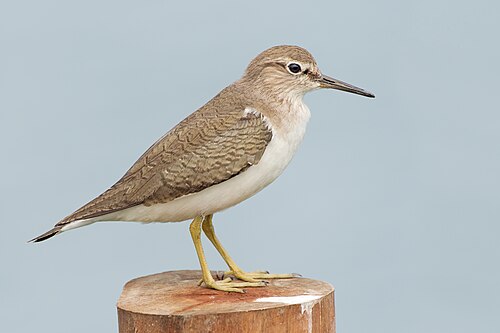
Common Sandpiper
Actitis hypoleucos

Whimbrel
Numenius phaeopus

Red-necked Phalarope
Phalaropus lobatus

Great Knot
Calidris tenuirostris

Curlew Sandpiper
Calidris ferruginea

Little Stint
Calidris minuta

Bar-tailed Godwit
Limosa lapponica
Global Distribution
Where this species is recorded worldwide. Restricted to human observations from 2019 onwards — the same kind of record and the same period the probabilities on this page are built from, so collar-tracking studies, camera-trap arrays and museum specimens are excluded. Around Santa Rosa that removes 5,924 GPS fixes from a handful of tagged jaguars.
where this species is recorded (GBIF density — it tracks where observers go, not how likely a sighting is) · parks where it occurs — tap a pin for the sighting probability there