


Rusty Blackbird
Euphagus carolinus
- KingdomAnimalia (Animals)
- PhylumChordata (Chordates)
- ClassAves (Birds)
- OrderPasseriformes (Perching Birds)
- FamilyIcteridae (New World Blackbirds and Orioles)
- GenusEuphagus (Rusty and Brewer's Blackbirds)
- SpeciesEuphagus carolinus (Rusty Blackbird)
About the Rusty Blackbird
The rusty blackbird (Euphagus carolinus) is a medium-sized New World blackbird, closely related to grackles ("rusty grackle" is an older name for the species). It is a bird that prefers wet forested areas, breeding in the boreal forest and muskeg across northern Canada, and migrating southeast to the United States during winter.
Formerly abundant, the rusty blackbird has undergone one of the most rapid declines of any abundant bird species in North America in recent years, for reasons that are not well understood. Adults have a pointed bill and a pale yellow eye. They have black plumage with faint green and purple gloss; the female is greyer. "Rusty" refers to the brownish winter plumage. They resemble the western member of the same genus, the Brewer's blackbird; however, Brewer's has a longer bill and the male's head is iridescent green.
Their breeding habitat is wet temperate coniferous forests and muskeg across Canada, New England, the Upper Peninsula of Michigan, the Adirondack Mountains in New York and Alaska. Birds usually nest at the edge of ponds and wetlands with the cup nest located in a tree or dense shrub, often over the water. Emerging dragonflies... Wikipedia →
Closest Relatives at Saguaro National Park

Brewer's Blackbird
Euphagus cyanocephalus

Great-tailed Grackle
Quiscalus mexicanus

Red-winged Blackbird
Agelaius phoeniceus

Brown-headed Cowbird
Molothrus ater

Hooded Oriole
Icterus cucullatus

Yellow-headed Blackbird
Xanthocephalus xanthocephalus

Bullock's Oriole
Icterus bullockii

Bronzed Cowbird
Molothrus aeneus

Western Meadowlark
Sturnella neglecta

Scott's Oriole
Icterus parisorum
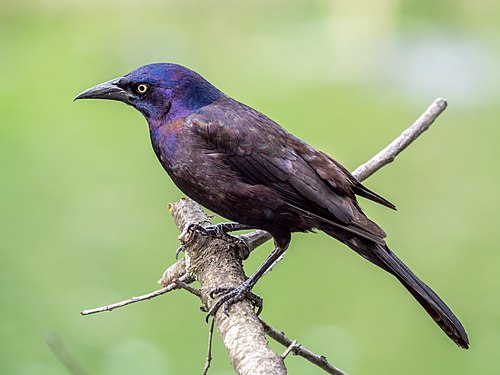
Common Grackle
Quiscalus quiscula

Baltimore Oriole
Icterus galbula
Global Distribution
Where this species is recorded worldwide. Restricted to human observations from 2019 onwards — the same kind of record and the same period the probabilities on this page are built from, so collar-tracking studies, camera-trap arrays and museum specimens are excluded. Around Santa Rosa that removes 5,924 GPS fixes from a handful of tagged jaguars.
where this species is recorded (GBIF density — it tracks where observers go, not how likely a sighting is) · parks where it occurs — tap a pin for the sighting probability there
Parks Where Found
Quick answers
What are the chances of seeing a Rusty Blackbird in Saguaro National Park?
Under 5% of wildlife watchers report a Rusty Blackbird sighting in Saguaro National Park, based on 14 verified sightings from GBIF citizen-science data.
When is the best time to see Rusty Blackbird in Saguaro National Park?
January has the highest sighting rate for Rusty Blackbird in Saguaro National Park in our monthly data.