


Say's Phoebe
Sayornis saya
- KingdomAnimalia (Animals)
- PhylumChordata (Chordates)
- ClassAves (Birds)
- OrderPasseriformes (Perching Birds)
- FamilyTyrannidae (Tyrant Flycatchers)
- GenusSayornis (Phoebes)
- SpeciesSayornis saya (Say's Phoebe)
About the Say's Phoebe
Say's phoebe (Sayornis saya) is a passerine bird in the tyrant flycatcher family, Tyrannidae. A common bird across western North America, it prefers dry, desolate areas. It was named for Thomas Say, an American naturalist.
Say's phoebe was formally described in 1825 by the French naturalist Charles Lucien Bonaparte from a specimen collected near Pueblo, Colorado. He coined the binomial name Muscicapa saya where the specific epithet was chosen to honour the American naturalist Thomas Say. The species is now placed in the genus Sayornis that was introduced by Bonaparte in 1854.
Two subspecies are recognised: S. s. saya (Bonaparte, 1825) – Alaska, west Canada, west USA and south Mexico S. s. quiescens Grinnell, 1926 – Baja California (northwest Mexico) Say's phoebe is a barrel-chested bird with a squared-off head. It is gray-brown above with a black tail and buffy cinnamon below, becoming more orange around the vent. The tail is long and the primaries end just past the rump on resting birds. The wings seem pale in flight and resemble a female mountain bluebird. The juvenile is similar to adult, but has buffy orange to whitish wingbars and a yellow gape... Wikipedia →
Closest Relatives at Saguaro National Park

Black Phoebe
Sayornis nigricans
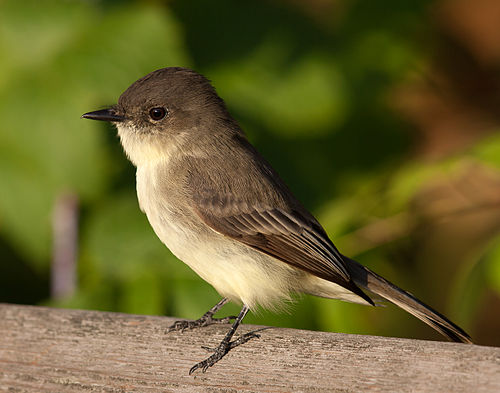
Eastern Phoebe
Sayornis phoebe

Vermilion Flycatcher
Pyrocephalus rubinus

Brown-crested Flycatcher
Myiarchus tyrannulus

Ash-throated Flycatcher
Myiarchus cinerascens

Cassin's Kingbird
Tyrannus vociferans

Western Kingbird
Tyrannus verticalis

Tropical Kingbird
Tyrannus melancholicus

Western Wood-Pewee
Contopus sordidulus

Pacific-slope Flycatcher
Empidonax difficilis

Gray Flycatcher
Empidonax wrightii

Greater Pewee
Contopus pertinax
Global Distribution
Where this species is recorded worldwide. Restricted to human observations from 2019 onwards — the same kind of record and the same period the probabilities on this page are built from, so collar-tracking studies, camera-trap arrays and museum specimens are excluded. Around Santa Rosa that removes 5,924 GPS fixes from a handful of tagged jaguars.
where this species is recorded (GBIF density — it tracks where observers go, not how likely a sighting is) · parks where it occurs — tap a pin for the sighting probability there
Parks Where Found
Quick answers
What are the chances of seeing a Say's Phoebe in Saguaro National Park?
About 20% of wildlife watchers report a Say's Phoebe sighting in Saguaro National Park, based on 8,966 verified sightings from GBIF citizen-science data.
When is the best time to see Say's Phoebe in Saguaro National Park?
November has the highest sighting rate for Say's Phoebe in Saguaro National Park in our monthly data.