


Harris' Hawk
Parabuteo unicinctus
Silhouette: Edwin Price · PhyloPic
- KingdomAnimalia (Animals)
- PhylumChordata (Chordates)
- ClassAves (Birds)
- OrderAccipitriformes (Hawks, Eagles, Kites, and Allies)
- FamilyAccipitridae (Hawks, Eagles, and Kites)
- GenusParabuteo (White-rumped and Harris's Hawks)
- SpeciesParabuteo unicinctus (Harris' Hawk)
About the Harris' Hawk
Parabuteo unicinctus is a medium-large bird of prey that breeds from the southwestern United States south to Chile, central Argentina, and Brazil. It contains two subspecies, the Harris's hawk (P. u. harrisi) and the bay-winged hawk (P. u. unicinctus). The species is also occasionally referred to as the dusky hawk and known in Latin America as the peuco.
Harris's hawk is notable for its behavior of hunting cooperatively in packs consisting of tolerant groups, while other raptors often hunt alone. Harris's hawks' social nature has been attributed to their intelligence, which makes them easy to train and has made them a popular bird for use in falconry.
The name is derived from the Greek para, meaning beside, near or like, and the Latin buteo, referring to a kind of buzzard; uni meaning once; and cinctus meaning girdled, referring to the white band at the tip of the tail. John James Audubon gave this bird its English name in honor of his ornithological companion, financial supporter, and friend Edward Harris.
Robert Ridgway placed Harris's hawk in its own new subgenus Urubitinga (Antenor) in 1873, and introduced the generic name Parabuteo in 1874. Richard... Wikipedia →
Recent sightings of Harris' Hawk in Santa Rosa National Park
LIVEiNaturalistClosest Relatives at Santa Rosa National Park

 Roadside Hawk
Rupornis magnirostris

 Common Black-Hawk
Buteogallus anthracinus

 Broad-winged Hawk
Buteo platypterus

 Gray-lined Hawk
Buteo nitidus

 Mississippi Kite
Ictinia mississippiensis

Crane Hawk
Geranospiza caerulescens

Short-tailed Hawk
Buteo brachyurus

Double-toothed Kite
Harpagus bidentatus

 Gray-headed Kite
Leptodon cayanensis

Great Black-Hawk
Buteogallus urubitinga

Swainson's Hawk
Buteo swainsoni
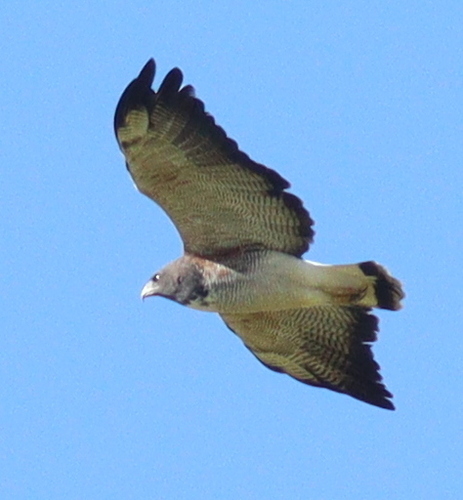
White-tailed Hawk
Buteo albicaudatus
Global Distribution
Warmer areas are where this animal is recorded most often.
Parks Where Found
Quick answers
What are the chances of seeing a Harris' Hawk in Santa Rosa National Park?
Under 5% of wildlife watchers report a Harris' Hawk sighting in Santa Rosa National Park, based on 17 verified sightings from GBIF citizen-science data.
When is the best time to see Harris' Hawk in Santa Rosa National Park?
December has the highest sighting rate for Harris' Hawk in Santa Rosa National Park in our monthly data.